An essay rough draft is the first full version of your essay: every point from your outline written out in sentences and paragraphs, before any attempt to make it read well. Its job is to give you a complete argument to look at and improve.
That is a different job from the final draft's, and it calls for different habits. In the experiments described below, how polished the first version was made no difference to the quality of the writing, while planning before it did.
Quick answer: A rough draft turns your outline into paragraphs so you can see the whole argument and then revise it. Write from your thesis and outline, begin with whichever section comes easiest, keep going past weak sentences, and leave yourself a note wherever something is missing. Save sentence polishing and proofreading until the argument and its order are settled.
What an essay rough draft is for
A first draft is where ideas become prose. The University of Maryland Global Campus writing center describes it as your initial attempt to organize your thoughts in prose, more complete than an outline because the ideas are developed in sentences and paragraphs. Its advice for this stage is to focus on the content and disregard spelling, punctuation and grammar.
Drafting is one part of a longer process. The US Institute of Education Sciences practice guide Teaching Secondary Students to Write Effectively (Graham and colleagues, 2016) lists the components as planning, goal setting, drafting, evaluating, revising and editing. The guide calls them recursive: a writer may go back to drafting after revising, or change goals after evaluating a first draft.
A draft is also where you find out what you think. The UNC Writing Center's handout on revising drafts calls writing "a process of discovery" and notes that revision sometimes means changing the thesis to match what you discovered while writing.
What research says about drafting and revising
In Kellogg's experiments, writing a rough first version did not by itself improve the writing. The evidence is stronger for planning beforehand, and studies of revision describe what experienced writers do afterwards.
| Study | Who and what | What was found |
|---|---|---|
| Kellogg (1987) | College students, with outlines and rough drafts tested | Outlining led to higher-quality writing. Rough drafts affected neither quality nor efficiency |
| Kellogg (1988) | Two experiments on outlines and rough drafts | Writing the first draft roughly, and not in polished form, did nothing for quality |
| Torrance, Thomas and Robinson (2000) | Questionnaires about 715 term papers by undergraduate psychology students | "Minimal drafting", typically one or at most two drafts, was one of the two weakest strategies. Differences were small |
| Faigley (1981) | 18 writers: six inexperienced students, six advanced students, six expert adults | Inexperienced writers' revisions were overwhelmingly surface changes |
| Graham and Perin (2007) | Meta-analysis of writing instruction studies, grades 4 to 12 | Average weighted effect size of 0.32 on writing quality for the process writing approach |
Kellogg (1987) tested whether outlines and rough drafts improve college students' writing. Kellogg (1988) started from the idea that drafting roughly might free a writer's attention. According to the abstract, it did not raise the quality of the documents, while a written outline did.
Neither paper is an argument against rough drafts. Together they suggest that writing roughly is not a technique in its own right, and that the plan you draft from carries more weight.
With real coursework, writing very few drafts was one of the weaker patterns. Torrance, Thomas and Robinson (2000) sorted undergraduates' accounts of how they wrote 715 term papers into four strategies. The "minimal-drafting" strategy and "outline-and-develop" appeared to produce the poorest results. The "detailed planning" strategy, which counted rough drafting among its ways of developing content, appeared to do better. The authors describe the differences as small.
How writers revise seems to depend on experience. In a research report on 18 case studies, which ERIC lists as a report and meeting paper and not as a journal article, Faigley (1981) had each writer make notes, write an essay and then write a second draft over three days. The inexperienced students' changes were overwhelmingly surface changes, which the report defines as formal and meaning-preserving ones. The expert adults' changes were spread more evenly between surface changes and what the report calls text-base changes, its other category. The experts were also the least frequent revisers, so the difference lay in the kind of change and not in the number.
A research report by Nancy Sommers, indexed by ERIC with the date 1982 and also not a journal article, followed eight first-year college students and seven experienced adult writers through three compositions, each rewritten twice. According to the abstract, revision was not a separate stage for the experienced writers. It ran through the whole process, and their first drafts were already the product of choosing some ideas and rejecting others.
For school-age writers there is evidence on teaching the whole process. In Graham and Perin's (2007) meta-analysis of writing instruction for students in grades 4 to 12, the process writing approach had an average weighted effect size of 0.32 on writing quality, and peer assistance 0.75. The IES guide rates its first recommendation, teaching strategies for each component of the writing process, as backed by strong evidence from 11 studies of students in grades 6 to 12.
Two of these sources are case studies of 15 and 18 writers, the meta-analysis and the guide concern school students, and most were read here as abstracts. None of them promises a grade.
From outline to essay rough draft, step by step
1. Put the thesis and outline in front of you
Write from your thesis statement and your notes, as the Maryland guide puts it. If you don't have a plan yet, writing an essay outline covers getting from the question to a working thesis, main points and evidence.
2. Begin wherever you can
You don't have to start with the first sentence. The UW–Madison Writing Center's page on introductions says plainly that you do not need to write the introduction first: some writers draft it midway, once they see the paper's direction, and others write it last.
Purdue OWL's page on writer's block gives the same cure for a writer who has a topic and an outline but no opening: start with any section you like and leave the introduction until later.
3. Give each outline point a paragraph
Each main point becomes a paragraph. The Maryland guide's order for a body paragraph is a topic sentence, the research that supports it, an explanation of what that research means, and a connection back to the thesis. 5 paragraph essay structure sets out those parts in more detail.
4. Keep moving, and leave notes
Purdue OWL's page has three habits for this stage. Finish the full draft before you edit at the sentence level. When you can't find the right word, type a placeholder and look for the better term later. When you're unsure of a detail, leave yourself a note to check the source later.
UNC's handout adds: don't proofread as you go, because you may spend time correcting the commas in a sentence that ends up being cut.
If starting is the hard part, a second Purdue OWL page of writer's block strategies suggests small goals, such as two paragraphs in an hour, and setting a timer for ten minutes of continuous writing. The Pomodoro technique for students is another way of working in timed blocks.
5. Carry your sources into the draft
Your outline should already show the source and page beside each piece of evidence. Copy them into the draft with the evidence, even in rough form. UNC's handout lists "Have you cited all your information appropriately?" among its revision checks, and that question is quicker to answer when the citations are already in place. How to paraphrase without plagiarizing covers putting source material into your own words, and how to paraphrase in APA style covers one common citation format.
6. Stop, then step away
When the whole argument is on the page, the draft has done its job. UNC's handout says to wait before you look at it again, and that a day, or even a few hours, will work.
A filled-in example: one outline point as a rough paragraph
The paragraph below is an example written for this article. It drafts one point from the sample outline in the outlining guide linked above, and its bracketed notes show the habit described in step 4.
Outline point
II. Experiments link outlining to higher-rated writing
   A. Kellogg (1987): college students who outlined wrote better texts
   B. Kellogg (1988): judges rated outlined documents higher

Rough draft
Experiments suggest that outlining helps. Kellogg (1987) tested
college students and found that outlines improved the quality of
their writing, but did not make it more efficient [say what
"efficient" means here - check the paper]. A year later he reported
two more experiments, and judges rated the documents written from
an outline higher (Kellogg, 1988). [ADD the mental outline result.
Here or its own paragraph?] So outlining seems like a good idea.
[Weak ending. Tie back to thesis.]
| What the rough paragraph already has | What is left for revision |
|---|---|
| The point, stated in the first sentence | A sharper topic sentence |
| Both pieces of evidence, with author and year | A detail to check and a result to place |
| The order of the argument | A closing sentence that connects to the thesis |
What to leave for revision
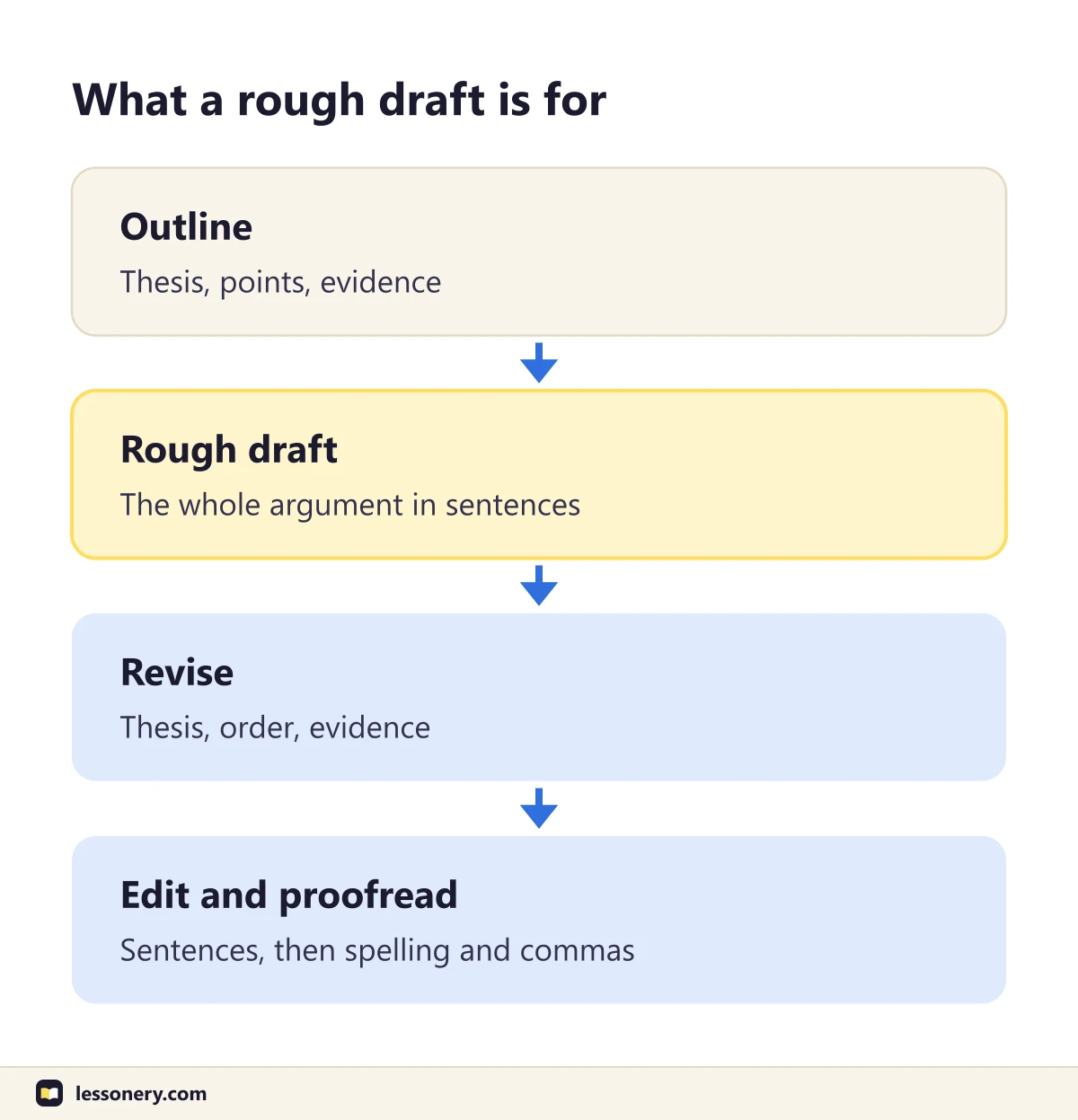
Revision has an order, and it runs from large to small. UNC's handout quotes a writing handbook's rule, "THINK BIG, don't tinker", and separates three activities: revising (rethinking the argument, evidence and organization), editing (rewording), and proofreading (commas and spelling), with proofreading last. The University of Toronto's advice on revising and editing, by Margaret Procter, uses the heading "Start Large, End Small".
| Leave for this pass | Questions to ask | Source |
|---|---|---|
| Revising the argument | Does the essay answer the assignment? Do you still agree with your thesis? | UNC, Toronto |
| Revising the organization | Is each section in the right place? Would the paper work better with parts moved? | UNC, Toronto |
| Editing | Are the word choices precise and the sentences clear? | UNC, Toronto |
| Proofreading | Are the spelling and punctuation correct? | UNC |
A reverse outline, described in the UNC handout on reorganizing drafts, lists what each paragraph of the draft actually does so you can compare it with your plan.
A reader helps too. The UNC handout on getting feedback suggests questions suited to a rough draft: does the paper make sense, does it prove its thesis, is the evidence clearly explained, and is the information in a logical order? Check your course's rules on collaboration before you share a draft.
Frequently asked questions
How long should an essay rough draft be?
None of the sources cited here sets a length. UNC's handout advises producing plenty of material in a first draft, because the more you write, the more you have to work with when you cut. By that reasoning, a rough draft can run longer than the finished essay will.
Does a rough draft need an introduction and a conclusion?
Not at first. UW–Madison's page says the introduction can be written midway or last, and advises checking it against the finished paper before you submit. Until then, your working thesis can stand in for it.
How many drafts should I write?
No source here gives a number. In the Torrance study, the strategy that typically involved one or at most two drafts was one of the two that appeared to produce the poorest results, though the differences were small. The author of UNC's handout reports writing six drafts of it.
Should I revise while I draft?
Some of it is fine. UNC's handout says writing is circular and that tinkering as you go is acceptable, with two risks: you never look at the whole essay, and you lose ideas that haven't reached the page yet. Its advice is to keep time for a full read once the draft is finished.