How to paraphrase without plagiarizing comes down to two requirements. You restate the source's idea in your own words and your own sentence structure, and you say where the idea came from. Miss either one and the result is not an honest paraphrase.
University writing centers teach this as a short routine: understand the passage, put it away, rewrite, compare, cite.
Quick answer: Read the passage until you can explain it, put the source out of sight, and write the idea from memory with a new sentence structure and your own words. Then compare your version with the original, put quotation marks around any distinctive phrase you kept, and cite the source. A paraphrase always needs a citation.
What a paraphrase is, and what it is not
A paraphrase restates one passage of a source in your own words, in a new form, with credit to the source. Purdue OWL's page on paraphrasing describes it this way and adds that a paraphrase is more detailed than a summary, which reduces a passage to its main point.
It is also a way of reading. Purdue OWL points out that working out a passage's meaning in your own words deepens your understanding of the original, which puts paraphrasing close to the checks in strategies to improve reading comprehension.
This table follows Purdue OWL's comparison of quoting, paraphrasing and summarizing.
| Way of using a source | What you do | Length compared with the original | Citation needed? |
|---|---|---|---|
| Quotation | Reproduce a short segment word for word, inside quotation marks | Identical | Yes |
| Paraphrase | Put one passage into your own words | Usually a little shorter | Yes |
| Summary | Put only the main ideas into your own words | Much shorter | Yes |
What a paraphrase is not: a lightly edited copy. The UNC Writing Center's handout on plagiarism says that changing a word or two, rearranging a sentence, or substituting synonyms stays too close to the original and is still plagiarism.
How to paraphrase without plagiarizing: five steps
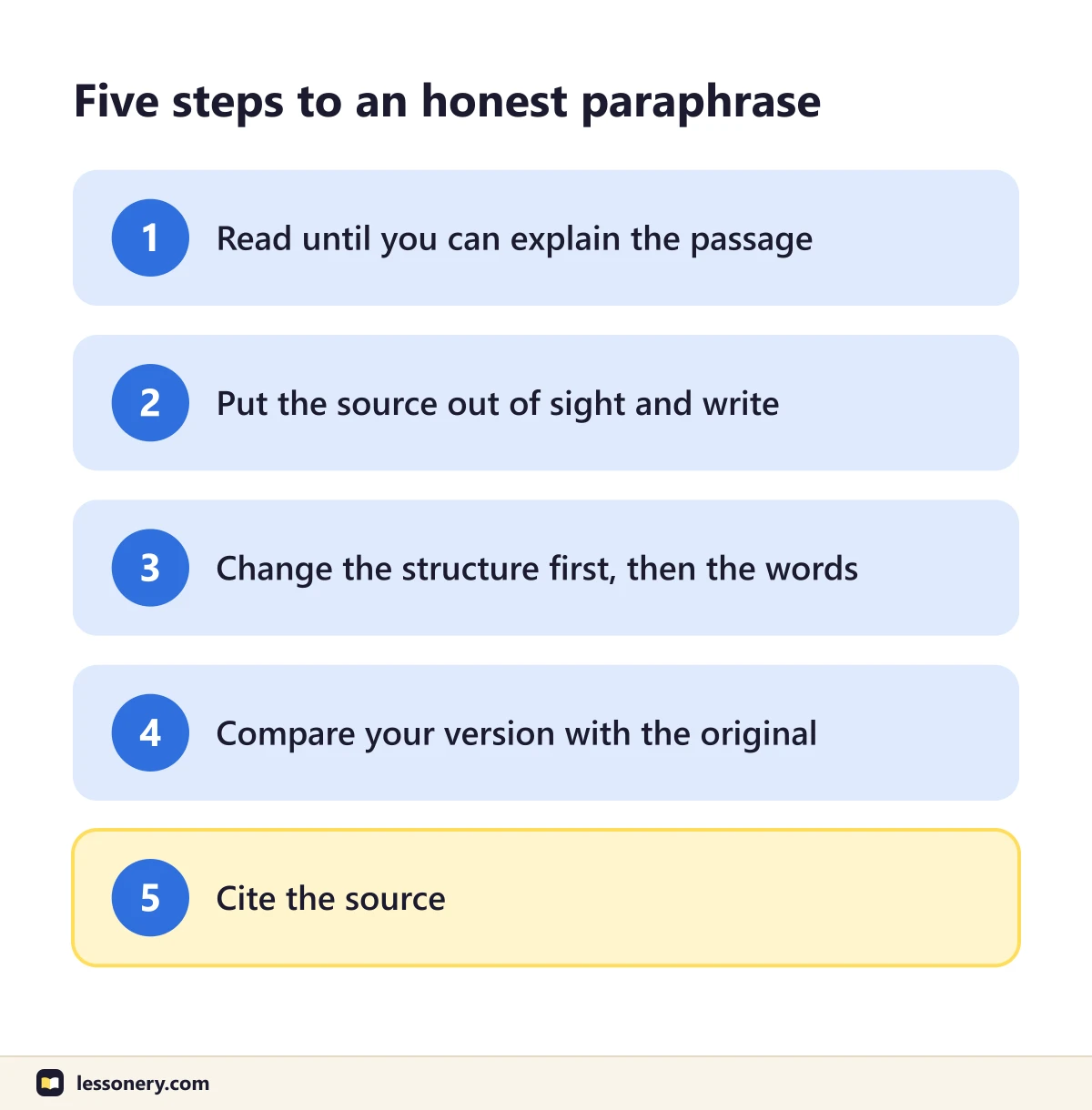
These steps combine Purdue OWL's six-step method with the paraphrasing advice in the UW–Madison Writing Center's handout on quoting and paraphrasing. The grouping into five is this article's. The advice inside each step is theirs.
1. Read until you can explain the passage
Reread the original until you understand its full meaning. That is Purdue OWL's first step, and Wisconsin's handout says the same: understand the whole passage before you write down specific ideas or phrases.
Wisconsin adds a useful test. Picture yourself explaining the passage to someone who doesn't know the subject. If the passage is dense, work through it first with the methods in how to annotate a text.
2. Put the source out of sight and write
Set the original aside and write your version from memory. Purdue OWL and Wisconsin both give this instruction, and UNC's handout recommends writing notes with the book closed for the same reason: it helps you use your own words.
Wisconsin offers a second route if writing from memory feels too hard. Take short, abbreviated notes, set them aside, and paraphrase from the notes later, for example the next day. If you can do neither, the handout says, you may not fully understand the passage yet.
When you do copy exact words into your notes, UNC's advice is to put quotation marks around them, so that later you can tell the author's words from yours. Note taking from a textbook covers setting notes up.
3. Change the structure first, then the words
For difficult passages, Wisconsin's handout recommends a fixed order: restructure, then reword. Start from a different point in the passage, perhaps with the people involved, and break up or combine sentences. Only then replace words with your own.
Structure matters as much as vocabulary. The guide to ethical writing that Miguel Roig of St. John's University wrote for the US Office of Research Integrity (ORI) states that using your own words is not enough, because a paraphrase also needs your own sentence structure.
4. Compare your version with the original
Put the two side by side and check two things. First, meaning: Purdue OWL asks you to confirm that your version carries all the essential information, and the ORI guide's summary of what writing guides say requires a paraphrase to reproduce the exact meaning of the source's ideas or facts.
Second, leftover phrasing. If a distinctive term or phrase from the source survived in your version, Purdue OWL's instruction is to put it in quotation marks.
5. Cite the source
Record the source, including the page number, so you can credit it in your paper. This is Purdue OWL's final step, and UNC's handout is blunt about it: a completely paraphrased idea still needs a citation, and so does a sentence that already names the author.
Which citation style you use is your institution's decision. UNC's handout advises finding out which style the assignment requires and following the official manual for it. APA has its own conventions, covered in how to paraphrase in APA style.
A worked example: near-copy versus paraphrase
Note: The "original passage" below was written for this article so that it can be shown in full. The author name, year and page number are invented placeholders that show where a citation goes. The author-date format is only an illustration. Use the style your course requires.
Original passage
When the school replaced its single long lunch break with two shorter ones, teachers expected the hallways to become noisier. The opposite happened. Because students no longer queued for the cafeteria at the same time, the crowding that had caused most of the pushing and shouting disappeared, and afternoon classes began on time more often.
Version A: too close
When the school swapped its one long lunch break for two shorter ones, teachers thought the hallways would get louder. The reverse happened. Since students no longer lined up for the cafeteria at the same time, the crowding that had led to most of the pushing and shouting vanished, and afternoon classes started on time more often (Rivera, 2021, p. 14).
Version B: an acceptable paraphrase
Rivera (2021) describes a timetable change that surprised the staff. They had predicted more noise once lunch was split into two short breaks. Instead, staggering the breaks meant the whole school was never waiting for food at once, so the corridors were less crowded and calmer, and fewer afternoon lessons started late (p. 14).
| Check | Version A | Version B |
|---|---|---|
| Sentence structure | Same three sentences in the same order | Opens with the author, and the sentences are rebuilt |
| Wording | Single words swapped for synonyms | New vocabulary throughout |
| Borrowed phrases | "at the same time", "most of the pushing and shouting" and "on time more often" kept without quotation marks | None |
| Meaning | Matches the original | Matches the original |
| Citation | Yes | Yes |
| Acceptable? | No | Yes |
Version A was edited in place, sentence by sentence. Version B follows steps 2 and 3: it starts from a different point, reorders the surprise and its cause, and uses the writer's own words.
Notice that both versions are cited. The citation is necessary, and in Version A it is not sufficient. The gap between the two versions is the whole of how to paraphrase without plagiarizing: new structure, new words, the same meaning, and a citation.
Patchwriting: when a near-copy counts as plagiarism
Patchwriting is a restatement that keeps too much of the source's wording or sentence structure. Santa Clara University's writing center, which borrows its definitions from the Citation Project, defines it along those lines and notes that it can happen even when a student is trying to use their own words. Version A is patchwriting.
The UNC and Wisconsin handouts classify a near-copy as plagiarism, and Wisconsin's gives the reason. It shows a "patchwork paraphrase" that credits the author but mixes the author's phrases with the student's words, with no quotation marks. The source is acknowledged, yet the borrowed phrases are still presented as the student's own writing.
The ORI guide makes the same point about what it calls inappropriate paraphrasing, described there as "perhaps the most common form of plagiarism" and also the most controversial. On its page of good and bad examples, a footnoted version with a handful of substituted words is still classed as plagiarism.
Not every authority uses the word "plagiarism" for every case. The Council of Writing Program Administrators' statement on plagiarism reserves the term for deliberate use of someone else's language or ideas without acknowledgment, and treats a good-faith attempt at crediting sources that goes wrong as misuse of sources. Santa Clara's page likewise notes that novices in a discipline may patchwrite while they learn.
Other institutions draw no such line. UNC's handout explains that its university's rules cover reckless as well as deliberate plagiarism, so a student who didn't know the rules is treated the same as one who did. Read your own institution's policy. Under any of these definitions the repair is identical: rewrite the passage and cite it.
Why near-copies are hard to spot in your own work
Two papers suggest that telling a near-copy from a paraphrase is harder than it sounds. In two studies, Roig (1997) gave undergraduates an original paragraph and several rewritten versions to judge. According to the abstract, about 74% of students correctly identified the properly paraphrased versions, but some plagiarized versions were judged to be correct paraphrases by as many as 40% to 50% of students.
Holt (2012) reported a similar pattern with 148 undergraduate ecology students, who labeled paragraphs correctly about three-quarters of the time. Most recognized properly paraphrased, quoted and attributed text. They had much more trouble with paraphrases that contained copied strings of up to 15 words, and with good paraphrases that had no citation. Students who had received plagiarism training did significantly better.
Both descriptions come from the papers' abstracts. They suggest that a quick glance is a poor check, which is the case for the deliberate side-by-side comparison in step 4.
What you can keep: shared language and common knowledge
Some words don't need changing. Wisconsin's handout calls this shared language and gives three kinds: conventional designations such as "physician's assistant", preferred bias-free language such as "persons with disabilities", and technical terms such as "material culture". The ORI guide's good paraphrases keep "membrane" and "sodium" for the same reason: there is no adequate substitute.
Common knowledge needs no citation. Wisconsin describes it as facts found in many standard reference works, plus material familiar to readers in a particular field. UNC suggests two questions: did you know this before the course, and did the idea come from your own thinking? A "no" to either means cite it.
Deciding which paraphrase supports which point belongs to the planning stage, covered in writing an essay outline.
Frequently asked questions
How many words do I have to change?
None of the guides cited here gives a number. They ask for your own words and your own sentence structure, and UNC's handout says that swapping a word or two is not enough. The side-by-side comparison in step 4 is a better test than counting words.
Is accidental plagiarism still plagiarism?
That depends on your institution. UNC's handout says students who plagiarize without realizing it are treated the same as those who do it deliberately, while the Council of Writing Program Administrators separates deliberate plagiarism from honest misuse of sources. Read your school's policy, and if you're unsure whether a passage is too close, ask your instructor before you submit.
Is it acceptable to use a paraphrasing tool or an AI tool?
Rules on paraphrasing software and AI tools differ between institutions and between courses, so follow your own. Whatever the rule, the idea still belongs to the source and still needs a citation. Purdue OWL's point also holds: doing the restating yourself is what builds your understanding of the passage.