How to paraphrase in APA Style comes down to two jobs. The first is the paraphrase itself: the source's idea in your own words and your own sentence structure. The second is the citation, which in the 7th edition of the American Psychological Association (APA) manual means the author's name and the year, matched by an entry in your reference list.
The rewording skill has its own guide, how to paraphrase without plagiarizing. What follows is the citation side, taken from the guidance APA publishes on its APA Style website.
Quick answer: Restate the idea in your own words, then cite the author and year, either in parentheses, as in (Rivera, 2021), or in the sentence, as in Rivera (2021). APA Style does not require a page number for a paraphrase, though you may add one. If a paraphrase runs for several sentences, cite the source at the first mention and again when you start a new paragraph.
What APA Style says about paraphrasing
APA's page on paraphrases defines a paraphrase as a restatement of another person's idea, or of an idea from your own earlier published work, in your own words. It says published authors paraphrase their sources most of the time, and that student writers should do the same and paraphrase more than they quote.
The page on quotations gives the reason: paraphrasing lets you fit the material to the context of your paper and to your own writing style. It keeps direct quotation for three cases, which are an exact definition, something an author said memorably or succinctly, and wording you want to respond to.
A paraphrase always needs a citation. APA's basic principles of citation state that both paraphrases and quotations require one, and that each work you cite in the text must also appear in the reference list.
Swapping a few words is not enough. APA's page on plagiarism uses the word patchwriting for text in which a few words have been changed but the content is largely the same, and the APA Style blog post on translations linked further down says patchwriting is considered a form of plagiarism.
The APA page lists Sections 8.23 and 8.24 of the Publication Manual (7th edition) as the place where paraphrases are covered in full.
How to cite a paraphrase in APA Style: two formats
APA Style uses an author–date system, and an in-text citation can take one of two forms. APA's page on parenthetical versus narrative citations describes them this way:
- Parenthetical: the author's name and the year go in parentheses, separated by a comma. The citation can sit inside the sentence or at its end.
- Narrative: the author's surname is part of your sentence, and the year follows it in parentheses.
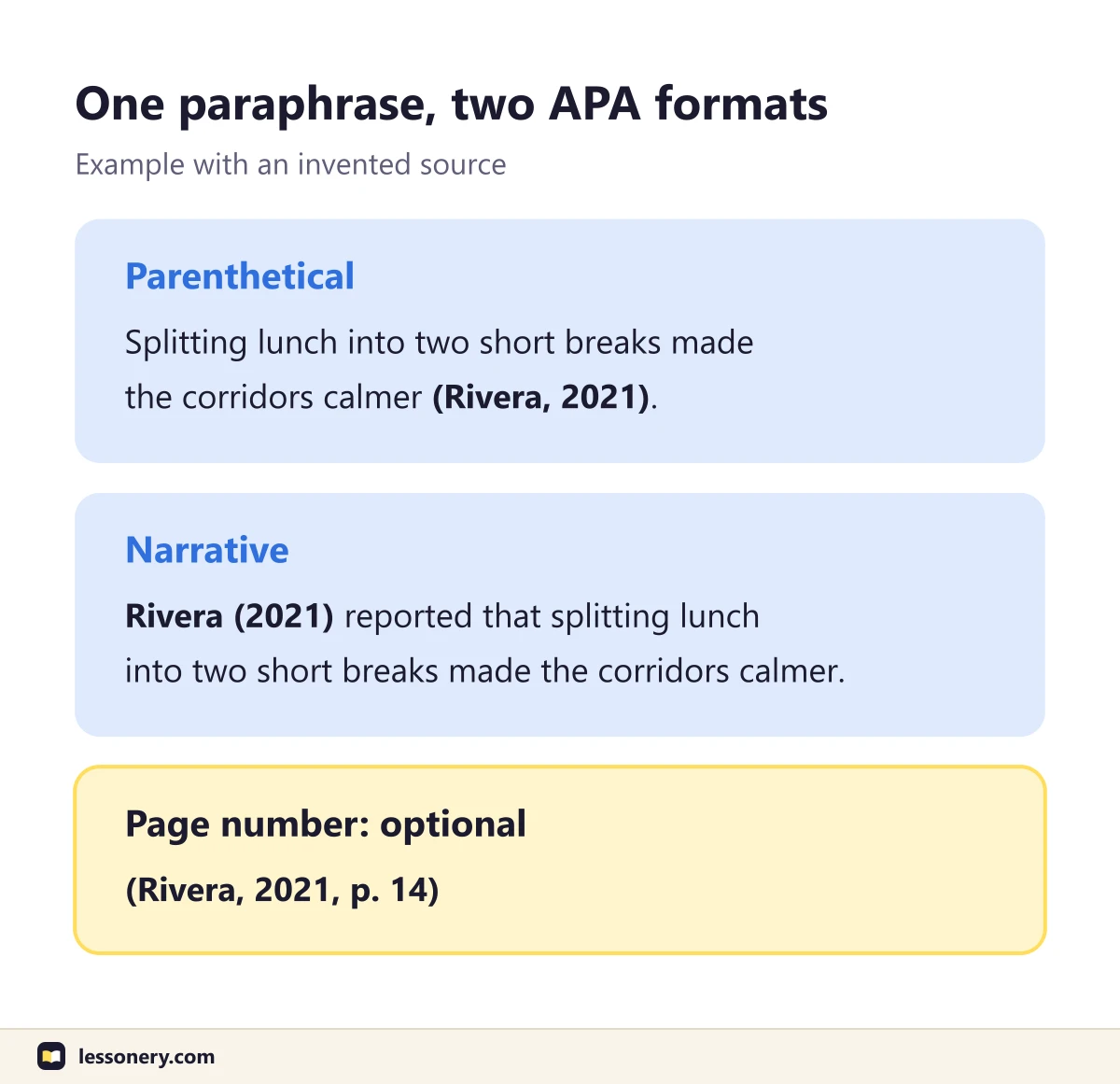
Here is one paraphrase cited both ways.
Splitting lunch into two short breaks made the corridors calmer (Rivera, 2021).
Rivera (2021) reported that splitting lunch into two short breaks made the corridors calmer.
Note: Every source in this article's examples (Rivera, Okafor and Lindqvist, Tanaka and colleagues, the Riverside School Board) is an invented placeholder that shows where a citation goes. The example sentences were written for this article. They are not taken from APA.
The author part changes with the number of authors. The formats in this table are those in APA's guide to the author–date citation system. The names are this article's placeholders.
| Authors | Parenthetical citation | Narrative citation |
|---|---|---|
| One | (Rivera, 2021) | Rivera (2021) |
| Two | (Okafor & Lindqvist, 2019) | Okafor and Lindqvist (2019) |
| Three or more | (Tanaka et al., 2020) | Tanaka et al. (2020) |
| A group | (Riverside School Board, 2022) | Riverside School Board (2022) |
Two details from the same APA page are easy to miss. Inside parentheses, two authors are joined by an ampersand (&), while in a narrative citation the word "and" is spelled out. For three or more authors, only the first author's name is given, followed by "et al.", in every citation including the first.
Do you need a page number for a paraphrase?
No. APA's paraphrasing page says a page or paragraph number is not required in the citation of a paraphrase. You may add one to the author and year when it would help an interested reader find the passage in a long or complex work, and the page's example of such a work is a book.
University guides describe the rule in slightly different tones. Purdue OWL's guide to APA in-text citations says a paraphrase needs only the author and year, and adds that APA guidelines encourage a page range when it helps the reader locate information in a longer work. The University of Alabama Libraries' APA guide puts it as required for direct quotes and encouraged for paraphrasing.
A quotation is different. APA's quotations page says a direct quotation always carries the page number, or another locator such as a paragraph number, in the same sentence.
| What you are citing | What goes in the citation | Example (invented source) |
|---|---|---|
| A paraphrase | Author and year. A page or paragraph number is optional | (Rivera, 2021) |
| A paraphrase from a long work, when a locator helps | Author, year, page | (Rivera, 2021, p. 14) |
| A direct quotation | Author, year, and always a page or other locator | (Rivera, 2021, p. 14) |
| A source you met only inside another source | Original author, then "as cited in" the source you read | (Rivera, 2021, as cited in Tanaka et al., 2023) |
| Your own translation of a passage | Author and year, as for any paraphrase. A page number is recommended | (Rivera, 2021, p. 14) |
The "as cited in" wording comes from APA's page on secondary sources, which also advises finding and reading the original work where you can and citing secondary sources sparingly. Only the source you actually read goes in your reference list.
The last row matters if you read in one language and write in another. An APA Style blog post on citing your own translations explains that a passage you translate yourself counts as a paraphrase, not a direct quotation, so it takes no quotation marks. The post recommends giving the page number, if there is one, so that readers of the original language can find the passage.
For the abbreviations, Purdue OWL's guide gives "p." for a single page and "pp." for several, with an en dash in a range, as in pp. 14–15.
Long paraphrases: when to repeat the citation
A paraphrase may run for several sentences. APA's paraphrasing page says to cite the work at its first mention, and that you need not repeat the citation while the context makes it clear that the same work is still being paraphrased.
Two events restart the count, according to the same page:
- A new paragraph. If the paraphrase continues into a new paragraph, bring the citation back.
- A change of source. If the passage draws on several sources or switches between them, repeat the citations so the reader can tell which idea came from where.
APA's page on the appropriate level of citation names both ways of getting this wrong. Undercitation can lead to plagiarism. Overcitation, such as repeating the same citation in every sentence when the source and the topic have not changed, is described as distracting and unnecessary.
One more rule applies when you name the author again in the same paragraph. APA's author–date page says to leave the year out of the second and later narrative citations within a paragraph, and to include the author and year in every parenthetical citation. If your paper cites more than one work by the same author, keep the year every time.
When one sentence rests on several sources, APA's page on citing multiple works says to list them alphabetically inside one pair of parentheses, separated by semicolons: (Okafor & Lindqvist, 2019; Rivera, 2021).
A worked example in APA Style
The passage below is an example written for this article. It reuses the invented source from the worked example in the paraphrasing guide linked above, and it shows a long paraphrase that crosses a paragraph break.
Rivera (2021) describes a timetable change that surprised a school's staff. Teachers had predicted more noise once lunch was split into two short breaks. Instead, Rivera explains, staggering the breaks meant the whole school was never waiting for food at once, so the corridors were less crowded and calmer.
The change also affected teaching time. Rivera (2021) reported that fewer afternoon lessons started late, a result that a later survey of 12 schools did not find everywhere (Tanaka et al., 2023).
| Sentence | What the citation is doing |
|---|---|
| Paragraph 1, sentence 1 | Narrative citation at the first mention: author in the sentence, year in parentheses |
| Paragraph 1, sentence 2 | No citation. The context shows that Rivera is still the source |
| Paragraph 1, sentence 3 | The author is named again in the same paragraph, so the year is left out |
| Paragraph 2, sentence 1 | The writer's own linking sentence, so there is nothing to cite |
| Paragraph 2, sentence 2, first half | A new paragraph has begun, so the citation returns with its year |
| Paragraph 2, sentence 2, second half | A second source enters and gets its own parenthetical citation |
To add a page number, the first sentence could end with "(p. 14)" after the paraphrased material. That is where APA's own example of a paraphrase with page numbers puts them.
When your instructor's requirements differ
APA's own pages leave room for the people who set your assignment to ask for something different, and one university library guide says so directly.
- Page numbers. The Oakwood University library's APA guide tells students to check with their instructor to see whether page numbers are required for paraphrases.
- Amount of quotation. APA's quotations page notes that instructors, programs, editors and publishers may set limits on direct quotation, and suggests asking if you think your paper has too much.
- Secondary sources. APA's advice to read and cite the original comes with the qualifier "unless an instructor has directed you to do otherwise".
Where an assignment sheet, a course handbook or your instructor says something different from this article, follow them. The same applies to which edition and which citation style you use at all.
Recording the author, year and page while you take notes makes all of this easier, because an optional page number costs nothing if you already have it. Note taking from a textbook covers that habit, and writing an essay outline shows where each paraphrase sits in the plan for a paper.
Frequently asked questions
Does a paraphrase need quotation marks in APA Style?
No. The University of Iowa Libraries' APA guide says a paraphrase takes no quotation marks but still needs a citation. If you keep an exact phrase from the source, that phrase is a quotation: put it in quotation marks and give the page number.
Can I put one citation at the end of the paragraph?
APA's guidance on how to paraphrase in APA Style describes the opposite order. You cite the work at its first mention, and the following sentences can go without a citation while it is clear they come from the same source. A citation that appears only at the end leaves the reader unsure where the borrowed material began.
How do I cite a paraphrase when the source has three or more authors?
Give the first author's surname followed by "et al." and the year, in both formats, from the first citation onward. APA's author–date page notes an exception: if two of your sources would shorten to the same "et al." form, write out as many surnames as it takes to tell them apart.
What if the source has no page numbers?
For a paraphrase nothing changes, because the page number was optional. APA's paraphrasing page mentions paragraph numbers as an alternative locator, and Purdue OWL's guide lists paragraph, chapter, section and table numbers as substitutes when a quotation comes from a source without pages.