The short version of how to study for a math final, the exam at the end of a course, is this: spend most of your time solving problems with the solutions closed. Mix the problem types so you practice choosing a method, use worked examples for the types you can't start, and write down every error so you can rework it.
Rereading notes and solved homework feels like revision because the steps look familiar. Following a solution and producing one are different skills, and the exam only asks for the second.
Quick answer: To study for a math final, start about a week ahead. Test yourself with one problem per topic to find the weak ones, alternate worked examples with similar problems on those topics, then switch to mixed sets and a timed practice paper. Keep an error log and rework every problem in it before the exam.
Why problem practice comes before rereading
Solving problems is the form of studying that matches a math exam, and university guidance is blunt about the proportions. Queen's University's Student Academic Success Services in Canada suggests that out of six hours of study for a math exam, about one should go to reading and five to solving problems. The Learning Center at the University of North Carolina at Chapel Hill says that in technical courses, working problems matters more than reading the text.
A research review by Dunlosky and colleagues (2013) assessed ten learning techniques. Practice testing received a high utility rating. Rereading received a low one, with the authors noting that rereading and highlighting do not reliably improve performance.
One caution about that evidence. Rohrer and colleagues, in the report of the trial described below, point out that the many studies favoring retrieval practice used verbal materials, and that its benefits have yet to be demonstrated for mathematics tasks other than fact learning. The more direct evidence for math concerns how practice problems are arranged and how worked examples are used. Those are the next two sections.
UNC's guide to math and physics learning strategies adds a practical rule: attempt a problem for about 10 to 15 minutes before you check your notes, then look at which parts you could do and which you missed.
Mix the problem types: what the interleaving studies found
Blocked practice means doing one type of problem at a time, which is how Rohrer and Taylor describe the practice sets in most mathematics textbooks. Interleaved (mixed) practice means arranging problems so that consecutive ones need different methods.
The argument for mixing is about what a final demands. In a chapter exercise you know the method before you read the problem. On a cumulative exam, one that covers the whole course, nothing tells you which chapter a question came from, so you have to choose the method as well as carry it out.
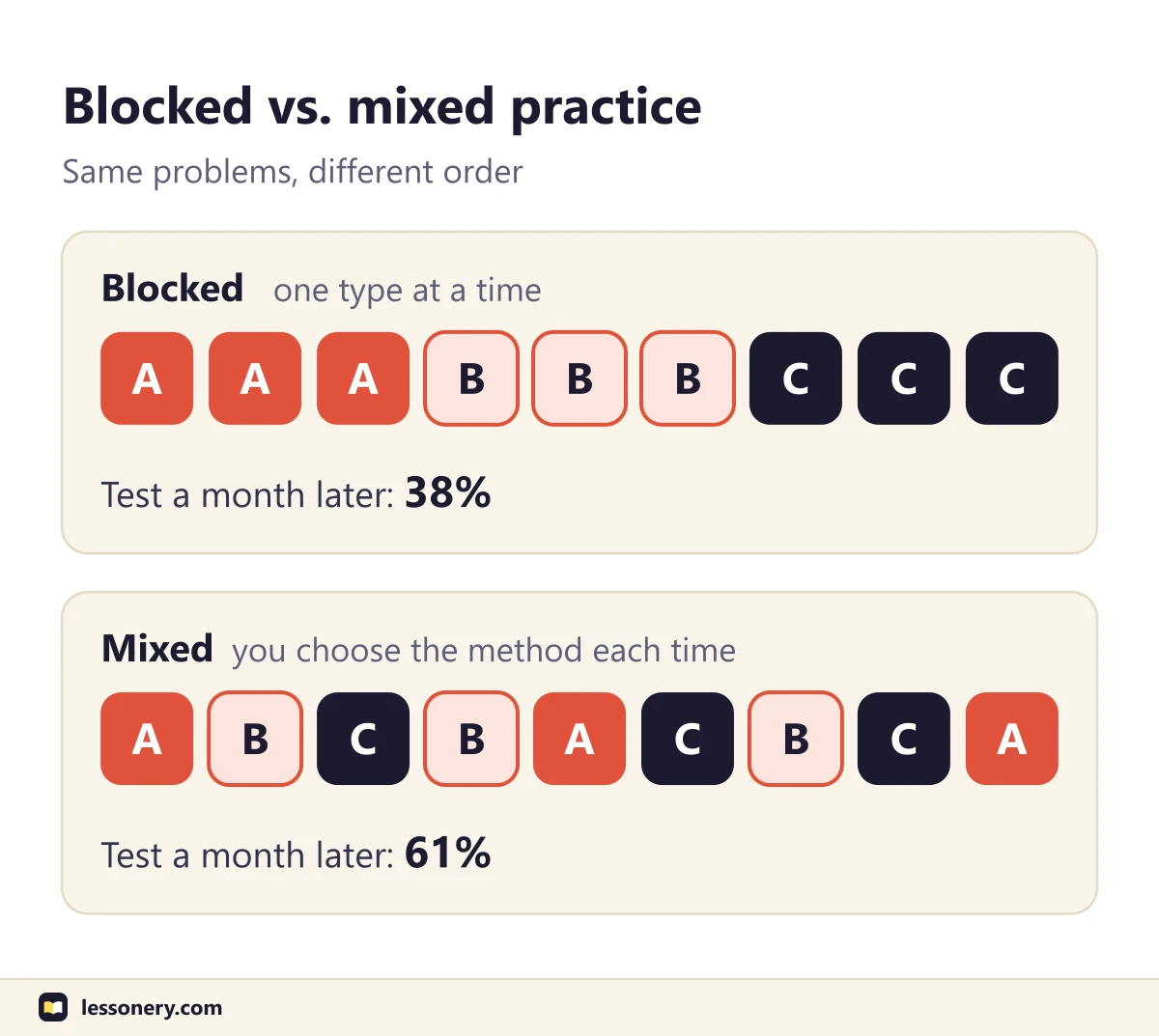
Two studies from one research group show the pattern:
- Rohrer and Taylor (2007) had college students learn several types of problem and then practice them either grouped by type or randomly mixed. On a test one week later, the students who had mixed practice performed far better.
- Rohrer, Dedrick, Hartwig and Cheung (2020) ran a randomized trial in 54 seventh-grade mathematics classes in Florida. For four months, classes received assignments that were mostly blocked or mostly interleaved, and then both groups completed an interleaved review. On an unannounced test one month later, the interleaved group scored 61% and the blocked group 38%. The US Institute of Education Sciences' What Works Clearinghouse review lists 787 students in the main sample and rates the study as meeting its standards without reservations.
How strong the evidence is
It is promising, with limits the authors state themselves. In the full text of the 2020 paper they list four caveats:
- Interleaved assignments probably take more time.
- The benefit may be smaller when the test comes soon after practice.
- Students may need some blocked practice first when a skill is new.
- In every study so far, students saw the solutions and corrected their errors, so feedback may be a necessary ingredient.
Dunlosky's review rated interleaved practice as moderate in utility because its effects had only begun to be studied.
Results on graded exams are less clear. Samani and Pan (2021) swapped blocked homework for interleaved homework in an introductory physics course at the University of California, Los Angeles, with 350 students taking part. Interleaving produced higher scores on surprise tests. Scores on the graded mid-course exams did not differ significantly, and the authors suggest that any benefit may have been hidden by practice testing and by cramming, which most students reported doing before those exams.
Use worked examples for the types you can't start
When you can't begin a problem, study a solved one and then solve a similar one straight away. The Institute of Education Sciences practice guide Organizing Instruction and Study to Improve Student Learning (Pashler and colleagues, 2007) recommends alternating worked examples with problems the student solves alone, and rates the evidence for this as moderate.
The guide describes laboratory experiments in algebra in which eighth- and ninth-grade students either alternated four worked examples with four problems or solved eight problems. The students who alternated took less time and did better on the test afterwards. The guide also notes that as students gain expertise, fewer examples and more problem solving appear to work better.
The guide is written for teachers. For self-study it translates into pairs:
- Read one worked example. Queen's suggests asking of each step what was done, how, and why.
- Close it and solve a similar problem on a blank page.
- Check your solution, then try another problem of that type with no example first.
Note: "Interleaving" is used for two different things. In the practice guide it means alternating examples with problems on one topic. In Rohrer's studies it means mixing problem types. A study plan can use both, at different stages.
Keep an error log
An error log is a running list of the problems you got wrong, what went wrong, and the correct method. The Ohio State University mathematics department recommends analyzing each wrong answer instead of discarding it, and keeping a notebook page headed "Warning: Errors to Avoid" with the correct method for each kind of error. It separates careless mistakes from errors that show you didn't know the method.
The log below is an example made for this article, with three invented entries.
| Problem | What I did | Kind of error | Correct method |
|---|---|---|---|
| Solve x² − 5x + 6 = 0 | Wrote x = −2, −3 | Careless slip (signs) | (x − 2)(x − 3) = 0, so x = 2 or x = 3. Check by substituting. |
| Differentiate x sin x | Wrote cos x | Did not see which rule applied | Product rule: sin x + x cos x. |
| Area of a circle with diameter 10 | Used r = 10 | Misread the question | r = 5, so area = 25π. |
The third column is the useful one. A page of slips tells you to slow down and check. A page of "did not see which rule applied" tells you to do more mixed practice. Rework every logged problem from a blank page a few days later, without looking at the correct method.
How to study for a math final: a sample week
The plan below is an example of how to study for a math final over seven days, built from the guidance above. It is not a schedule taken from any study. It assumes one or two study blocks a day, and you should adapt the days to your own timetable and other exams.
| Day | Main task |
|---|---|
| 7 days before | List the topics from the syllabus. Solve one problem per topic, timed, notes closed. Sort topics into "can do", "shaky" and "can't start". |
| 6 days before | "Can't start" topics: worked example, then a similar problem, in pairs. Log errors. |
| 5 days before | "Shaky" topics: problems first, examples only when stuck. End with a short mixed set. |
| 4 days before | Mixed set across all topics, shuffled so you can't tell the chapter. Check solutions, log errors. |
| 3 days before | Timed practice paper with only the materials your exam allows. Mark it. |
| 2 days before | Rework every error-log problem from a blank page. Second mixed set on the weakest topics. |
| 1 day before | Write out the formulas you must know. Short mixed set. Stop early. |
The diagnostic on the first day follows UNC's suggestion to solve one problem from each topic group under time pressure to see which topics need review. The formula step follows Ohio State's advice to list the formulas you need and practice writing them. Ohio State also advises starting early enough for an unhurried review and a full night's sleep before the test.
Whether you may bring a formula sheet or a calculator is decided by your institution. Practice under the same rules. To fit this week around other subjects, see how to create a study schedule.
Where this goes wrong
Three patterns undo an otherwise sensible plan:
- Mistaking recognition for skill. UNC warns that being able to do all the assigned problems can give a false sense of mastery. Its test is whether you can handle a changed version: a different scenario, different notation, or two concepts combined.
- Practicing only by chapter. If every set is blocked, you never practice the first step of an exam question, which is deciding what kind of problem it is.
- Starting the night before. Rohrer and colleagues point out that mixing problem types automatically spreads the practice of each type over time, and one night leaves no room for that. A spaced repetition schedule explains the idea. If you are already out of time, how to cram for an exam covers what to prioritize.
Frequently asked questions
How many days before a math final should you start studying?
The research cited here doesn't give a number of days. The practice guide recommends spacing learning over time, and the example above uses seven days so that each weak topic can be practiced, left alone and tested again. A shorter plan can keep the same order: diagnose, repair, mix, then a timed paper.
Is it better to redo old homework or try new problems?
Both have a use. Ohio State suggests redoing assigned homework problems to confirm you understand each procedure. UNC suggests going further with changed versions and exam-style problems, since a problem you have already seen is easier to recognize than a new one.
Why does mixed practice feel harder than doing one type at a time?
Because it is harder while you do it. Rohrer and colleagues report that mixing lowered scores during practice in the 2007 study, and the physics students in Samani and Pan's study rated interleaved assignments as more challenging and believed they learned less from them, although their surprise test scores were higher.
Do I need to memorize formulas?
That depends on your exam's rules. If no formula sheet is allowed, practice writing the formulas from memory, which is a kind of active recall. If a sheet is allowed, practice with that exact sheet so you know where everything is.