Spaced repetition for language learning means coming back to the same words and phrases after gaps of hours, days or weeks, instead of repeating them in one sitting. The research behind it is mostly about vocabulary: word pairs studied on cards or in exercises and tested later.
That research supports spacing for remembering what words mean. It says much less about speaking and listening, which is why a vocabulary researcher who recommends word cards also calls them just one step in learning a word.
Quick answer: A 2022 meta-analysis of 48 experiments (Kim and Webb) found that spacing had a medium-to-large effect on second-language learning, that longer gaps did better than shorter ones on delayed tests, and that equal and expanding gaps were statistically equivalent. Use spaced self-testing for words and phrases, and keep separate time for listening, reading, speaking and writing.
What spaced repetition means for a language learner
Spaced repetition has two parts: a gap between reviews, and an attempt to recall the word at each review. A second language (often written L2) is any language learned after your first, and most of the studies below taught L2 words as pairs, such as an English word and its Japanese translation.
The card format builds in the recall. In his guide What Do You Need to Know to Learn a Foreign Language?, issued by the School of Linguistics and Applied Language Studies at Victoria University of Wellington, the vocabulary researcher Paul Nation (2014) says to write the word on one side of a small card and its translation on the other, because this encourages you to recall the item. Each recall, he writes, strengthens the link between the word's form and its meaning, and seeing both together does not.
The general research on gaps is in the spaced repetition schedule guide, and the research on recall in the guide to the active recall method. The studies below are about spaced repetition for language learning specifically.
What research found on spaced repetition for language learning
The overall picture: Kim and Webb (2022)
Kim and Webb (2022) pooled earlier studies of spaced practice in second-language learning: 98 effect sizes from 48 experiments with 3,411 participants in total. Their abstract reports four results.
- The effect of spacing on second-language learning was medium to large.
- Shorter gaps were as effective as longer gaps on immediate tests, but less effective on delayed tests.
- Equal gaps and expanding gaps (each one longer than the last) were statistically equivalent.
- The size of the effect varied with features of the studies, including the learning target, the number of sessions, the type of practice and activity, the timing of feedback and the delay before the test.
Expanding versus equal gaps: Nakata (2015)
Nakata (2015) had 128 Japanese college students study 20 English-Japanese word pairs. He varied the type of spacing (expanding or equal) and the amount of spacing (massed, short, medium or long). Expanding spacing showed what the abstract calls a limited, yet statistically significant, advantage. The amount of spacing also had a significant effect, with large effect sizes, and the author concludes that introducing spacing may have a larger effect than the choice of pattern.
Nakata describes this as the first second-language study to find expanding spacing superior. In Kim and Webb's later meta-analysis the two patterns came out equivalent, and a meta-analysis of spaced retrieval practice across subjects by Latimier, Peyre and Ramus (2021) found no significant difference between them either (g = 0.034).
Spacing with flashcards and exercises: Kim and Webb (2023)
Kim and Webb (2023) had 150 Korean learners of English study 48 low-frequency English words. Four groups practiced with either flashcards or fill-in-the-blank exercises, either massed with no interval or spaced with a one-day interval, and a fifth group had no treatment. On a test two weeks later, spaced practice was more effective than massed practice for both activities, and the gains from the two activities did not differ overall. On the immediate test, spacing had helped the fill-in-the-blank groups more than the flashcard groups.
Recalls in one sitting: Nakata (2017)
Nakata (2017) asked how often to retrieve a word within a single session. Ninety-eight Japanese learners studied 16 English-Japanese word pairs at one of four retrieval frequencies (one, three, five or seven), and posttests were given after a delay of more than two weeks. Scores were significantly higher with five or seven retrievals than with one or three, whatever the timing of the posttest. Once the time each schedule took was taken into account, though, a single retrieval produced the largest gain.
Remembering for years: the Bahrick studies
Two older studies followed vocabulary over long periods. Dunlosky and colleagues (2013) describe an experiment by Bahrick (1979) in which students relearned Spanish word translations in sessions 0, 1 or 30 days apart. The 30-day group had forgotten the most at the start of each session and remembered the most on a final test 30 days after the last one.
Bahrick, Bahrick, Bahrick and Bahrick (1993) ran a nine-year study in which four people learned and relearned 300 English-foreign language word pairs. They had 13 or 26 relearning sessions at intervals of 14, 28 or 56 days, and were tested one to five years after training ended. Longer intervals slowed learning slightly during training and produced much better retention afterward. Thirteen sessions 56 days apart gave retention comparable to 26 sessions 14 days apart. The study is long and detailed, but it had only four participants.
| Study | Who and what | Main finding |
|---|---|---|
| Kim and Webb (2022) | Meta-analysis, 48 experiments, 3,411 participants | Medium-to-large effect of spacing; longer gaps better on delayed tests |
| Nakata (2015) | 128 Japanese college students, 20 word pairs | Limited but significant advantage for expanding gaps; large effects of the amount of spacing |
| Kim and Webb (2023) | 150 Korean learners, 48 English words | Spaced beat massed two weeks later, with flashcards and with fill-in-the-blanks |
| Bahrick et al. (1993) | Four people, 300 word pairs, nine years | 13 sessions 56 days apart gave retention comparable to 26 sessions 14 days apart |
What it covers, and what it does not
The studies above measured whether learners could recall or recognize word meanings. That is one part of knowing a language.
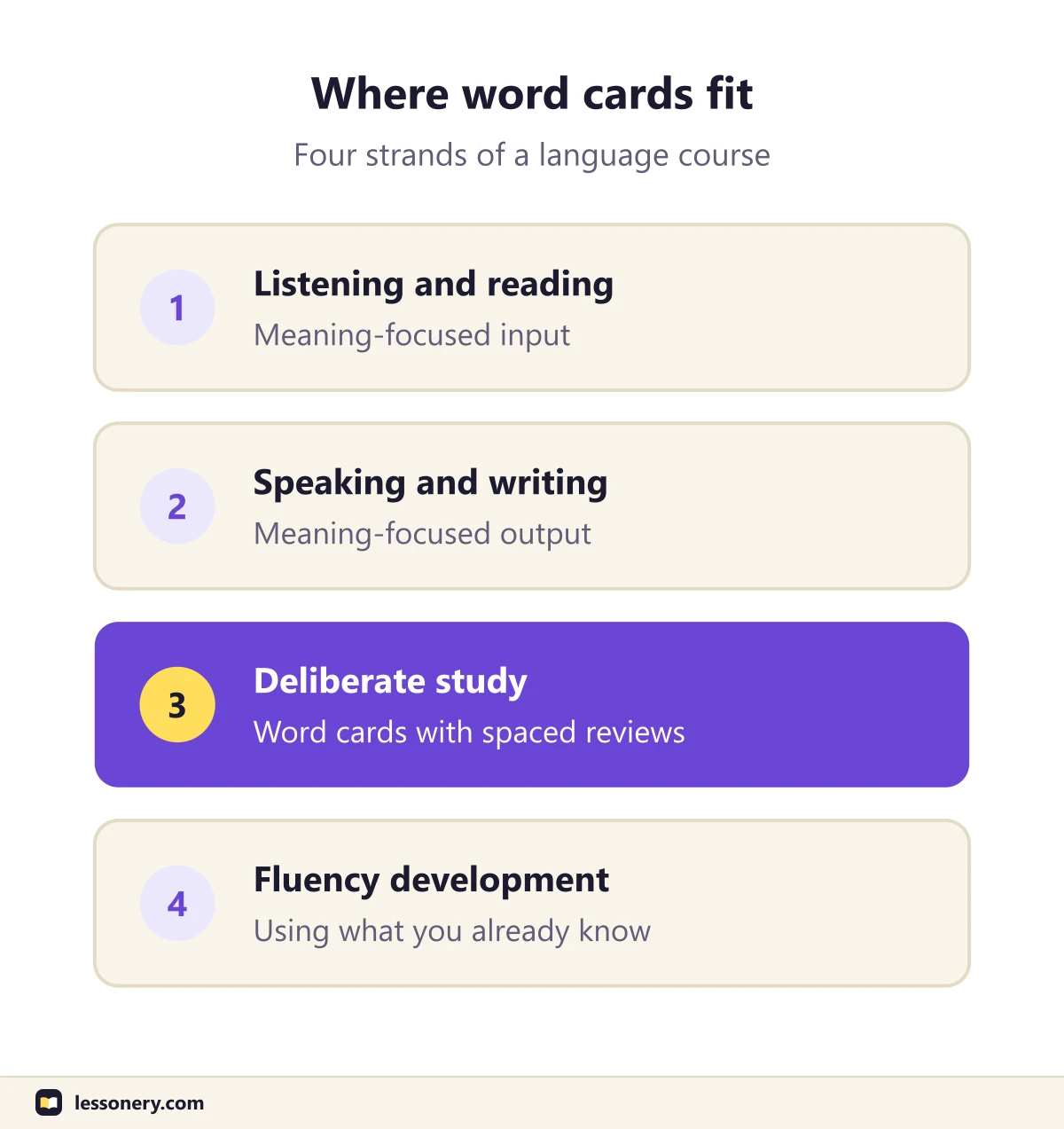
Nation's guide places word cards inside a larger plan. He describes four strands that need roughly equal amounts of time: learning from listening and reading (meaning-focused input), learning from speaking and writing (meaning-focused output), deliberate study of features such as pronunciation, vocabulary and grammar, and fluency development, which he defines as getting good at using what you already know. He places word cards in the third strand.
Research on spacing outside vocabulary exists, but there is less of it and the results are narrower.
- Speaking fluency. Kakitani and Kormos (2024) had 116 Japanese undergraduates practice telling picture stories in English in four sessions, either one day or seven days apart, or take the tests without training. Both trained groups improved on some fluency measures, such as pausing in the middle of clauses, and the two spacings did not differ significantly in their gains. The tasks were monologues, which the authors note do not capture interactive conversation.
- Hearing sound contrasts. Saito and Chen (2025) trained Mandarin speakers to tell apart two English vowels, as in pen and pan, in six sessions of about 10 minutes, with 53 learners in the final analysis. Learners whose sessions were spread over 15 days improved more than learners who did all six in one day, right after training and a week later. Equal and expanding gaps did not differ significantly.
Neither study tested flashcard review as a route to conversation or listening comprehension. On this evidence, a spaced card routine is a vocabulary tool. The gains in those two studies came from practicing the skill itself: telling stories aloud, or identifying the vowels heard.
How to set up spaced vocabulary review, step by step
These steps condense the word-card activity in Nation's guide.
- Make two-sided cards. The word or phrase goes on one side and the translation on the other. Add a phrase or sentence where it helps, which Nation says applies particularly to verbs.
- Start with small packs. He suggests about 15 or 20 words at first and says more than 50 seems to be unmanageable.
- Recall before you turn the card. Say the word aloud as well.
- Space the reviews. His suggested pattern is a few minutes after the first look, an hour or so later, the next day, a week later, then a couple of weeks later.
- Shuffle the pack. A fixed order lets one card cue the next.
- Keep look-alike and related words apart. Nation warns that days of the week, numbers, opposites and other close sets interfere with each other when learned together.
For words that will not stick, he suggests the keyword technique, which is described with its research in the article on memorization techniques for studying.
Note: Nation's pattern is an expanding one. The meta-analyses above found no significant difference between expanding and equal gaps, so evenly spaced reviews are a reasonable alternative if they are easier to keep.
An example routine for one pack of 15 words
This routine is an example made for this article. The spacing pattern is Nation's, and the dates and times are only an illustration.
| Review | When | What you do |
|---|---|---|
| First look | Monday, October 12, 2026, 7:00 p.m. | Write 15 cards and read each one |
| 1 | Monday, 7:10 p.m. | Go through the pack, recalling each word before turning the card |
| 2 | Monday, about 8:10 p.m. | Shuffle and repeat |
| 3 | Tuesday, October 13 | Shuffle and repeat; say each word aloud |
| 4 | Tuesday, October 20 | Shuffle and repeat |
| 5 | Tuesday, November 3 | Shuffle and repeat |
If you start a new pack every Monday, a Tuesday session in the fourth week holds three packs: this week's, last week's and the one from three weeks ago. That count is this article's arithmetic, not a figure from a study.
Flashcard apps such as Anki, whose manual explains the idea behind its scheduling, work out review dates automatically. A Leitner box does a rougher version of the same job with paper cards. Nation's guide treats the choice as a matter of preference: a flashcard program if you like using a phone or tablet, small cards otherwise.
Where a language routine goes wrong
| Problem | What the sources say | What to do |
|---|---|---|
| All the reviews happen on the day you meet the word | In Kim and Webb (2022), shorter spacing matched longer spacing on immediate tests and fell behind on delayed tests | Put at least one review on a later day and one a week or more out |
| Cards are the whole study plan | Nation gives deliberate study one of four roughly equal strands | Schedule listening, reading, speaking and writing as well |
| Looking at both sides together | Nation: seeing form and meaning together does not strengthen the link the way recall does | Cover the answer and commit to a response first |
Frequently asked questions
Does spaced repetition for language learning make you fluent?
The studies described here do not show that. They tested memory for vocabulary. In the one fluency study above, learners practiced speaking itself, and Nation's guide gives fluency practice its own share of study time.
Do the gaps have to keep getting longer?
No. Nakata (2015) found a limited advantage for expanding gaps in one experiment, but Kim and Webb (2022) found equal and expanding gaps statistically equivalent across studies. How to combine reviews with self-testing is covered in active recall and spaced repetition.
Is it better to learn words in context or on cards?
Nation argues for both. He calls word cards efficient and effective deliberate learning, and he also says vocabulary has to be met in context through listening, reading, speaking and writing.