Flow method note taking means writing down only the main ideas of a lecture, a few words each, and joining them with arrows while you listen. The page ends up as a loose web of linked ideas instead of a list. The method comes from the writer Scott Young, who called it flow-based notetaking.
It trades a complete record for thinking done in class. That trade is the thing to weigh, because research on note-taking gives a lot of weight to having full notes to review. One small classroom study has tested flow notes directly. The rest of the evidence is indirect.
Quick answer: Write each major idea in a few words, leave space, and draw arrows to show how it connects to ideas already on the page. Add small diagrams where they help. Scott Young, who described the method in 2008, says it gives up some later readability. For dense classes he suggests taking ordinary notes first and redrawing them as flow notes afterward.
What the flow method of note-taking is
Young set the method out in a chapter of his e-book Learn More, Study Less, which he posted on his blog on March 6, 2008. His starting point is a principle he calls "learn it once": listen to the instructor and process the material as it is said, instead of transcribing it to learn later.
In his description, the notes give you a surface for connecting ideas as they reach you. Four things define them:
- Major ideas only. A few words at most, not whole sentences. Facts, dates and descriptions are cut down the same way.
- Arrows. Once an idea is on the page, you draw arrows from it to other ideas.
- No ranked order. Ideas are shown as parts that relate to each other, like a web, and not as an ordered hierarchy.
- Extras that aid understanding. Small pictures, diagrams, metaphors and references to other subjects can hang off an idea.
Young calls the result messier than ordinary notes and says it can reduce readability later.
Two university pages teach the method in similar terms. The law library of the William S. Richardson School of Law credits the method to Young and sums it up in three principles: simplify by using your own words, visualize with diagrams and images, and make connections. Austin Peay State University's Writing Center, in its flow notes handout, tells students to write major ideas as short phrases or keywords, connect them with arrows, lines and shapes, and let the notes run across the page instead of following a strict outline.
How to take flow notes
The steps below combine Young's chapter with the two university pages.
- Decide what the core idea is. Young treats recognizing the critical information as the main skill of the method. Writing everything down with equal emphasis, he says, leaves you transcribing instead of thinking.
- Write it in a few words. Leave plenty of space around it, as the Austin Peay handout advises.
- Connect it. Draw arrows to the ideas it relates to. The law library guide lists three directions: back to earlier ideas, across to other topics, and out to things you already know.
- Add a sketch, a comparison or a reference to another subject where it helps you understand the idea.
- Use explanations and examples as working time. Young assumes that the critical information in a class can be recorded in less time than it takes to teach, and that the lecturer's examples leave room to draw the connections.
That assumption fails in some classes, and Young gives two hybrid versions for them.
| Version | What you do | When Young suggests it |
|---|---|---|
| Flow notes | Main ideas and arrows, made during class | The class leaves room for explanation and examples |
| Flow-based afternotes | Ordinary notes in class, recopied into flow form afterward | You have trouble keeping pace, or you are new to the method (he suggests this for the first month) |
| Flow-based commenting | Record the dense information first, then add the links when there is a break | Information comes faster than you can compress it, for example a few dozen formulas |
Young says afternotes take longer than either pure style but give both readability and understanding. That is his claim: no study found for this article has tested either hybrid.
How flow notes differ from linear notes and mind maps
Flow notes sit between a list and a diagram. The table below is a reading of the descriptions cited in this article and in the guides to the outline method and mind mapping for note-taking. It is a comparison of formats, not a finding from a study.
| Linear notes (outline or list) | Mind map | Flow notes | |
|---|---|---|---|
| Shape | Lines down the page, details indented under topics | One main idea in the center, with branches and twigs around it | Ideas spread over the page as they arrive |
| What shows relationships | Indentation | Position on a branch | Arrows between any two ideas |
| Hierarchy | By level of indentation | From the center outward | None by design |
| What is written | Phrases or sentences | Keywords | A few words per idea, plus sketches |
The law library guide says flow notes look like a hand-drawn mind map with arrows. Going by Young's description, the difference is that a mind map ranks everything from one center, while flow notes have no center and let any idea link to any other.
A filled-in example
The page below is an example made for this article, not a page from Young's book. It shows how flow notes might look for a short lecture segment on concept maps. The effect sizes come from a meta-analysis by Schroeder and colleagues (2018). The test scores come from Karpicke and Blunt (2011), a study described in the article on the active recall method.
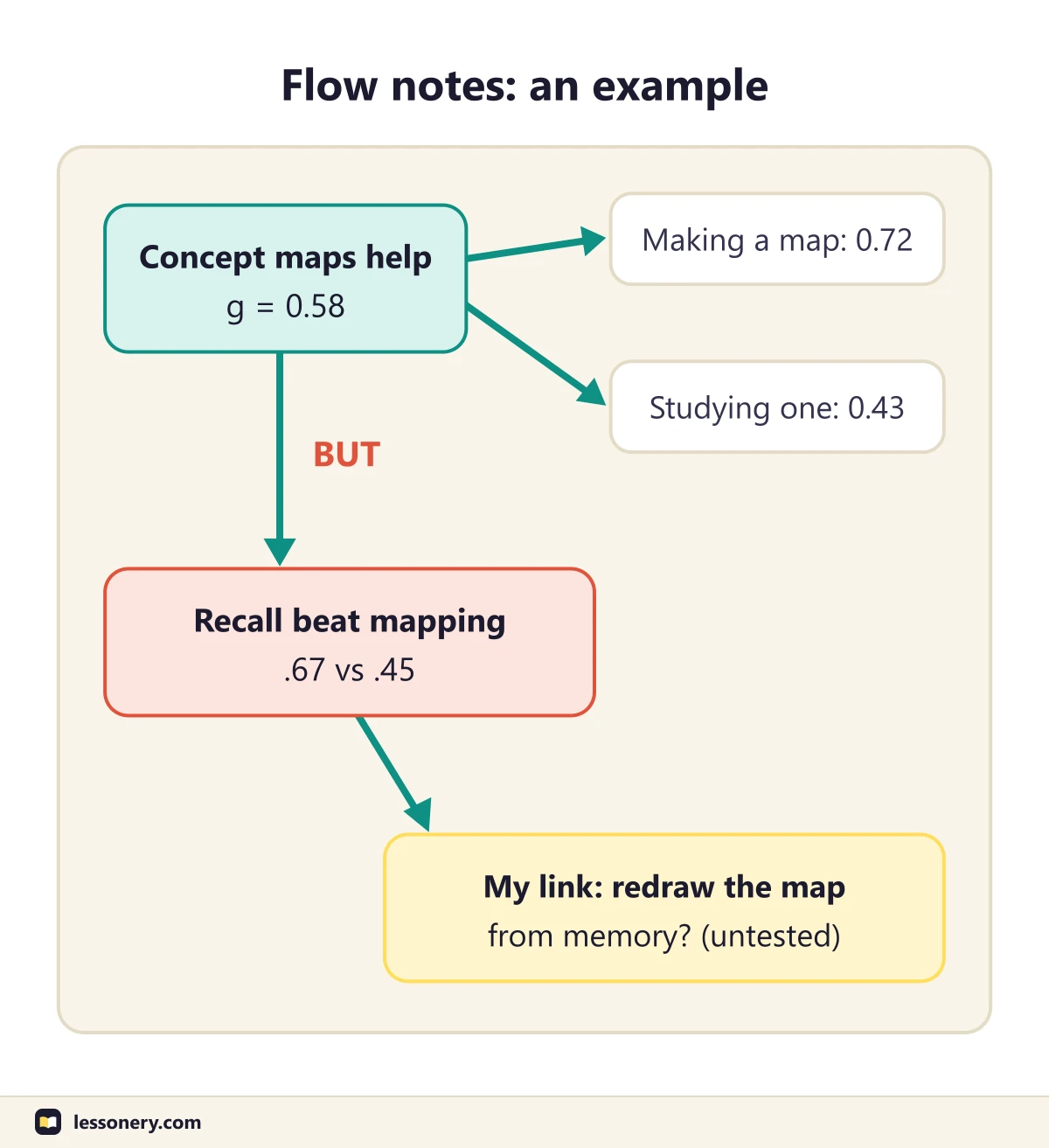
The same page as text:
CONCEPT MAPS help learning   (g = 0.58)
      |
      |---> MAKING a map: 0.72
      |---> STUDYING one already made: 0.43
      |
     BUT
      v
RECALL beat MAPPING with the text open
      (.67 vs .45, test one week later)
      |
      |---> my link: redraw the map from memory?  (untested)
Each idea is a few words. The arrows and the word "BUT" carry the relationships, including a result that cuts against the first one. The last line is the note-taker's own connection, marked as untested so that it isn't mistaken for a finding later.
The page also shows the cost. It doesn't say who took part or what they studied: in Karpicke and Blunt's first experiment, for instance, 80 undergraduates studied a science text. Details like these have to be added afterward from the slides or the reading.
What the evidence says about flow notes
One small classroom study
A search for this article found one study of the method itself. Badi (2024) worked with first-year students of English as a foreign language at Skikda University in Algeria, in a course called Introduction to General Linguistics. Two class groups of 36 students were chosen from twelve. One was trained in flow-based notetaking over about eight weeks, using prompts adapted from Young's book. The other had normal classes on the same content with no note-taking training.
Both groups took a written test on the course content before and after, with gap-fill, true-or-false and multiple-choice questions scored out of 20. The trained group's average rose from 8.13 to 14.87. The comparison group's went from 7.70 to 8.74, a change that was not statistically significant. The difference between the two groups after training was statistically significant. In interviews, all six students asked were positive about the method, and four described difficulties, among them a teacher speaking too fast for them to organize the notes.
This is thin evidence. The comparison group had no training of any kind, so the study compares being taught flow notes with being taught no method, not flow notes with another format. Whole class groups were assigned, not individual students. The paper gives the sample as 76 in its abstract and as two groups of 36 in its method section.
Related research on processing instead of transcribing
Young's premise is that thinking during the lecture beats transcribing it. Several lines of research bear on that idea. None of them tested flow notes.
Peper and Mayer (1986) ran two experiments in which people either took notes or did not while watching a videotaped lecture on car engines. According to the abstract, note-takers did better on far-transfer tasks such as problem solving and worse on near-transfer tasks. The paper's title calls these generative effects of note-taking.
Generative learning, as Fiorella and Mayer (2016) define it, means actively making sense of material by reorganizing it and integrating it with what you already know. Their review presents eight strategies intended to promote it. Mapping and drawing are two of them, and the meta-analysis used in the example above found a larger benefit from creating concept maps (g = 0.72) than from studying ready-made ones (g = 0.43). That result is about maps built as a learning activity, not notes drawn during a live lecture.
Mueller and Oppenheimer (2014) reported across three studies that students who took notes on laptops did worse on conceptual questions than students who wrote longhand. Their explanation was that typing invites word-for-word transcription without processing. A direct replication by Morehead, Dunlosky and Rawson (2019) found that test performance did not consistently differ between groups.
What flow notes give up
The record is the cost. In a research summary for instructors, Kiewra, Colliot and Lu (2018) report that students record, on average, about one third of a lesson's important ideas, and that the number of lesson points in a student's notes is positively correlated with achievement. They add that studies comparing the two functions of notes, taking them and having them to review, generally find the review function stronger.
Two meta-analyses point the same way. Kobayashi (2005) described the effect of taking notes without reviewing them as positive but modest, and Kobayashi (2006) found that taking and reviewing notes, compared with doing neither, had a substantial effect. In one experiment by Bui, Myerson and Hale (2013), participants who could study their notes before a delayed test recalled more if they had tried to transcribe the lecture than if they had taken organized notes.
What follows is reasoning, not a finding. Flow notes put their weight on the act of taking notes, the function the meta-analysis calls modest, and they shrink the record that review depends on. Young's afternotes version answers this: keep fuller notes in class and build the flow page afterward.
When flow method note-taking fits and when it doesn't
By Young's account and the law library guide's, flow notes suit classes that leave you time to think and suit dense classes poorly. These are their judgments, not tested results.
- Fits: classes where explanations and examples leave you time to think, by Young's account. The law library guide suggests the best use may be a review lecture, where you presumably already know the material.
- Fits poorly: classes so dense that you are writing constantly. Young calls pure flow notes almost impossible there. For a fast, heavy lecture, university guides point to the sentence method, which captures first and organizes later.
- Fits poorly: material you plan to study from your notes many times. Young says ordinary linear notes are useful in that case.
The comparison of different note-taking methods sets out the other formats, and the guide to taking notes in class covers the review that any format needs.
Frequently asked questions
Are flow notes the same as a mind map?
No. A mind map grows outward from one central idea in ranked branches. Flow notes have no center and no ranking: ideas go down as they arrive, and arrows can join any two of them.
Can you use flow notes in a fast lecture?
Young says it is almost impossible when you are writing frantically just to get everything down. He suggests recording the dense material first and adding the links during a break, or taking ordinary notes and converting them after class.
Is there research showing that flow notes work?
One small classroom study in Algeria found higher test scores after eight weeks of training, compared with a group that received no note-taking training. No study found for this article compared flow notes with another note-taking method.