Knowing how to study for a biology test starts with what the subject is made of: a large vocabulary and a set of processes, such as pathways and cycles, in which every step depends on the one before. The methods that fit are self-quizzing on terms, rebuilding each process from memory as a sketch, and explaining it without your notes.
Most of the research below comes from biology classrooms, much of it from the open-access journal CBE—Life Sciences Education. The general case for all sciences is covered in how to study for a science exam, and calculations and units in how to study for a chemistry test.
Quick answer: Write definitions before you check them, sketch each pathway from memory with a covered term list, explain processes aloud, and answer practice questions closed book. In one study of an introductory biology course, students who reported self-quizzing, explaining concepts and completing problem sets scored higher on exams than students who did not, after accounting for preparation, class absences and study time.
What a biology test asks for
Biology questions range from recalling a term to predicting what a system will do, and each kind needs its own practice. Crowe, Dirks and Wenderoth (2008) built the Blooming Biology Tool to classify questions by the levels of Bloom's taxonomy, and with it a list of study activities for students matched to each level.
| Level | Study activities the authors list |
|---|---|
| Knowledge | Practice labeling diagrams; quiz yourself with flash cards; take a self-made vocabulary quiz |
| Comprehension | Describe a process in your own words without copying it; give examples of it |
| Application | Ask what would happen if one component of the system increased, decreased or changed its activity |
| Analysis | Interpret data in a textbook before reading the author's interpretation; compare two concepts; map the main concepts with arrows that define their relationships |
| Synthesis | Design an experiment; make summary sheets showing how facts and concepts relate; write and take a practice test |
The table is a selection from the paper's list, which also has a sixth level, evaluation, and group versions of each activity. The authors note that the first two levels rely heavily on memorization, which flashcards and mnemonics can reinforce, and that the higher levels need other activities.
How much of a test sits at the higher levels depends on the course. In the introductory course studied by Walck-Shannon and colleagues, described next, 38% of exam points came from higher-order questions.
What higher-scoring biology students reported doing
Walck-Shannon, Rowell and Frey (2021) asked students in a large introductory biology course at a selective private university in the US Midwest how they had studied for two exams. Students filled in the survey after each exam and before they saw their grades. The analysis held four things equal: the mathematics score from the ACT (a US university admission test), a biology pretest, class absences and total study hours.
| What students reported | Share using it (exam 1) | Exam 1 difference | Exam 2 difference |
|---|---|---|---|
| Read lecture slides or class notes | 95% | not significant | not significant |
| Answered the problem set questions | 86% | +4.3 | +7.7 |
| Quizzed themselves (ungraded quizzes, flashcards) | 76% | +4.4 | +5.4 |
| Explained concepts to themselves or others | 65% | +5.5 | +6.3 |
| Made their own diagrams or comparison tables | 55% | +1.9 | not significant |
| Rewrote class notes word for word | 16% | not significant | −4.2 |
The differences are in percentage points of exam score between students who did and did not report each strategy, from the paper's Table 3 (424 students for exam 1 and 471 for exam 2).
Three other results from the same paper:
- Each additional active strategy a student used went with a score 1.9% higher on exam 1 and 2.8% higher on exam 2.
- Students began studying about 6 days before the exam on average, and how early they started was not related to their scores once total study time was held equal. The authors say they do not advocate cramming.
- Students reported being distracted for about 20% of their study time. Those who were distracted 10% more of the time scored about 1% lower.
The authors list the limits themselves. The habits were self-reported, the course was at one selective institution, and the analysis is correlational, so it cannot show that a strategy caused a score.
Vocabulary: test the definition, not the feeling of knowing it
Familiar terms are the ones students misjudge most. Walck-Shannon and colleagues note that undergraduate biology courses introduce a large amount of discipline-specific terminology, and one study looked at how well students know it. Zukswert, Barker and McDonnell (2019) asked students in two biology classes to rate how well they understood course vocabulary and then to define the terms, and analyzed 1,276 responses to 72 terms.
Students generally overestimated their understanding. Self-assessment was least accurate for terms the students had met often before and for terms that mean something different in biology than in everyday language.
The practical consequence is to make every vocabulary check a written one:
- Cover the definition and write your own.
- Compare it with the textbook's wording and correct it.
- Use the term in a sentence about a process, one of the comprehension activities in the Crowe list.
Flashcards do this job when you answer before you turn the card. See the active recall method and, for a way to schedule card reviews, the Leitner box.
Pathways and cycles: rebuild them from memory with a sketch
A method tested with biology students combines a quick sketch with a covered list of terms. Heideman, Flores, Sevier and Trouton (2017), at the College of William and Mary in the US, call it minute sketches with folded lists.
- The minute sketch is a simple diagram that uses the fewest lines and symbols that represent the concept to you, so that you can reproduce it in under a minute.
- The terms go in a list beside the sketch, never on it.
- The folded list hides one column at a time. You redraw the sketch from the terms, then rewrite the terms from the sketch, checking the hidden side when you need to.
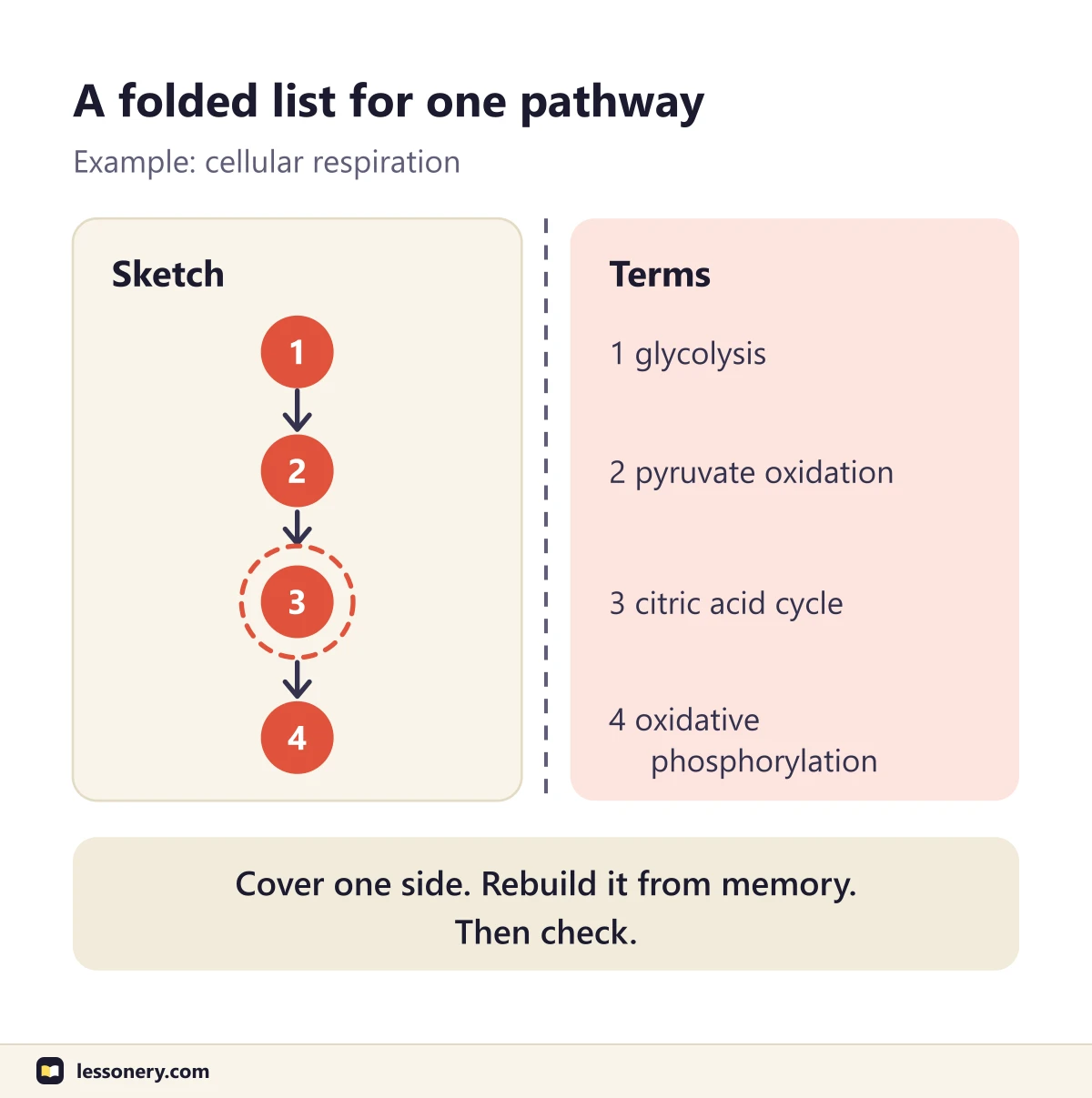
In the paper's third experiment, students from a first-semester biology course used two methods on matched material for the same amount of time: first on characters from an unfamiliar alphabet, then on two pages of unfamiliar biology content about thyroid hormones and metabolism. One page was studied with sketches and folded lists. The other was studied by visual review, the students' preferred method of looking over the material, which for some included looking away to test themselves.
Scored by investigators who did not know which method had been used, participants in that experiment recalled an average of 48% more of what they had studied with sketches and folded lists. Of the participants, 81% recalled more with that method and 14% recalled more with visual review. Problem-solving scores were better with the sketch method in some assessments but not in most, and were never worse.
The authors call the recall result unsurprising, because the method includes retrieval practice. Their caveats are small samples in the first two experiments and groups that cannot be assumed equivalent. The comparison was also with visual review, not with a written self-test. In the Walck-Shannon survey, making diagrams was related to higher scores on only one of the two exams.
Concept maps: what the evidence does and doesn't show
A concept map is a diagram in which labeled arrows state how concepts are related. Crowe and colleagues list it as an analysis-level activity, and the pooled research on it is positive, with one direct challenge.
- Nesbit and Adesope (2006) analyzed 55 studies with 5,818 participants, from Grade 4 to postsecondary level, and found that using concept maps was associated with better knowledge retention. Effects ranged from small to large depending on how the maps were used and what they were compared with.
- Schroeder and colleagues (2018) pooled 142 effect sizes from 11,814 participants and found a moderate overall benefit (g = 0.58). Creating a map (g = 0.72) helped more than studying one that was already made (g = 0.43).
- Karpicke and Blunt (2011) had 80 undergraduates study a science text. One group then built a concept map with the text in front of them, and another practiced recalling the text from memory. On a short-answer test one week later, the recall group averaged .67 of the available points and the concept-mapping group .45.
Karpicke and Blunt add that a map drawn with the text closed would itself be a form of retrieval practice. For a biology test, that suggests drawing the map from memory first and opening your notes only to repair it. No study described here tested that exact routine.
A concept map is not the same thing as a mind map. The article on mind mapping for note-taking explains the difference and the separate evidence for each.
How to study for a biology test: an example plan for one topic
The plan below is an example made for this article, using cellular respiration. The content follows the OpenStax textbook Biology 2e: its sections on glycolysis, on pyruvate oxidation and the citric acid cycle and on oxidative phosphorylation. Your course may ask for more or less detail.
| Stage | Where | Goes in | Comes out |
|---|---|---|---|
| 1. Glycolysis | Cytoplasm | Glucose | 2 pyruvate, a net 2 ATP, 2 NADH |
| 2. Pyruvate oxidation | Mitochondrial matrix | Pyruvate | Acetyl CoA, carbon dioxide, NADH |
| 3. Citric acid cycle | Mitochondrial matrix | Acetyl group from acetyl CoA | Per turn: 2 carbon dioxide, 3 NADH, 1 FADH₂, 1 ATP or GTP |
| 4. Oxidative phosphorylation | Inner mitochondrial membrane | Electrons from NADH and FADH₂, oxygen | ATP, water |
The locations are those in eukaryotic cells (cells with a nucleus); in prokaryotes, the textbook says, the electron transport chain is in the plasma membrane. Stage 4 has no ATP total because the textbook gives none: it says the number of ATP molecules made from one glucose varies, for example between species. If your course teaches a figure, learn that one.
The studying is what you do with that table closed:
| Session | Task | Level practiced |
|---|---|---|
| Day 1, first block | Write a definition for each term (pyruvate, acetyl CoA, NADH, electron transport chain, ATP synthase), then check. | Knowledge |
| Day 1, second block | Draw a minute sketch of the four stages with a term list beside it. Cover each side in turn and rebuild it, twice. | Knowledge, comprehension |
| Day 3 | Rebuild the sketch from the terms. Explain the whole pathway aloud. Answer one "where" question and one "what if" question. | Comprehension, application |
| Day 5 | Practice questions, closed book. Mark them and redo the ones you missed. | All levels on your test |
Two questions for this topic: where is carbon dioxide released, and what happens if no oxygen is available? The first is answered by stages 2 and 3 of the table. For the second, start from the fact that oxygen is the final electron acceptor of the electron transport chain.
Practice on three separate days follows the pattern used in the Heideman experiments, in which participants practiced for a few minutes on each of three days before a quiz. A spaced repetition schedule explains the reasoning for the gaps.
Common mistakes
| Mistake | What the research above found | What to do |
|---|---|---|
| Only rereading slides and notes | Not related to scores (Walck-Shannon et al.) | Use it as a first pass, then quiz yourself |
| Rewriting notes word for word | Related to lower scores on one of two exams | Reorganize into a sketch or table from memory |
| Judging terms by familiarity | Students overestimated their understanding of familiar terms (Zukswert et al.) | Write the definition before checking |
| Studying while distracted | Related to lower exam scores | See how to stay focused while studying |
Frequently asked questions
How many days before a biology test should I start studying?
The students in the Walck-Shannon study started about 6 days ahead on average, and starting earlier was not related to higher scores when total study time was the same. The authors still advise against cramming, and point out that students who start earlier may study more.
Are flashcards enough for a biology test?
They cover part of it. Crowe and colleagues place flashcards at the knowledge level, which relies on memorization. Questions that ask you to predict, interpret data or design an experiment need the other activities in their list.
Should I rewrite my notes to study for a biology test?
Copying them word for word was related to lower scores on one of the two exams in the Walck-Shannon data. The University of British Columbia's Science Peer Academic Coaches give matching advice for biology: don't rewrite notes, reorganize the concepts to create new connections, and draw your own diagrams and flow charts.