The short version of how to study for a science exam: work on processes, not only on lists of terms. Explain each process aloud with your notes closed, redraw the diagrams from memory, and spend the rest of your time on practice questions, including the ones built around a table or a graph.
This article covers the general case across school and university sciences. Two subjects have their own guides: how to study for a biology test and how to study for a chemistry test.
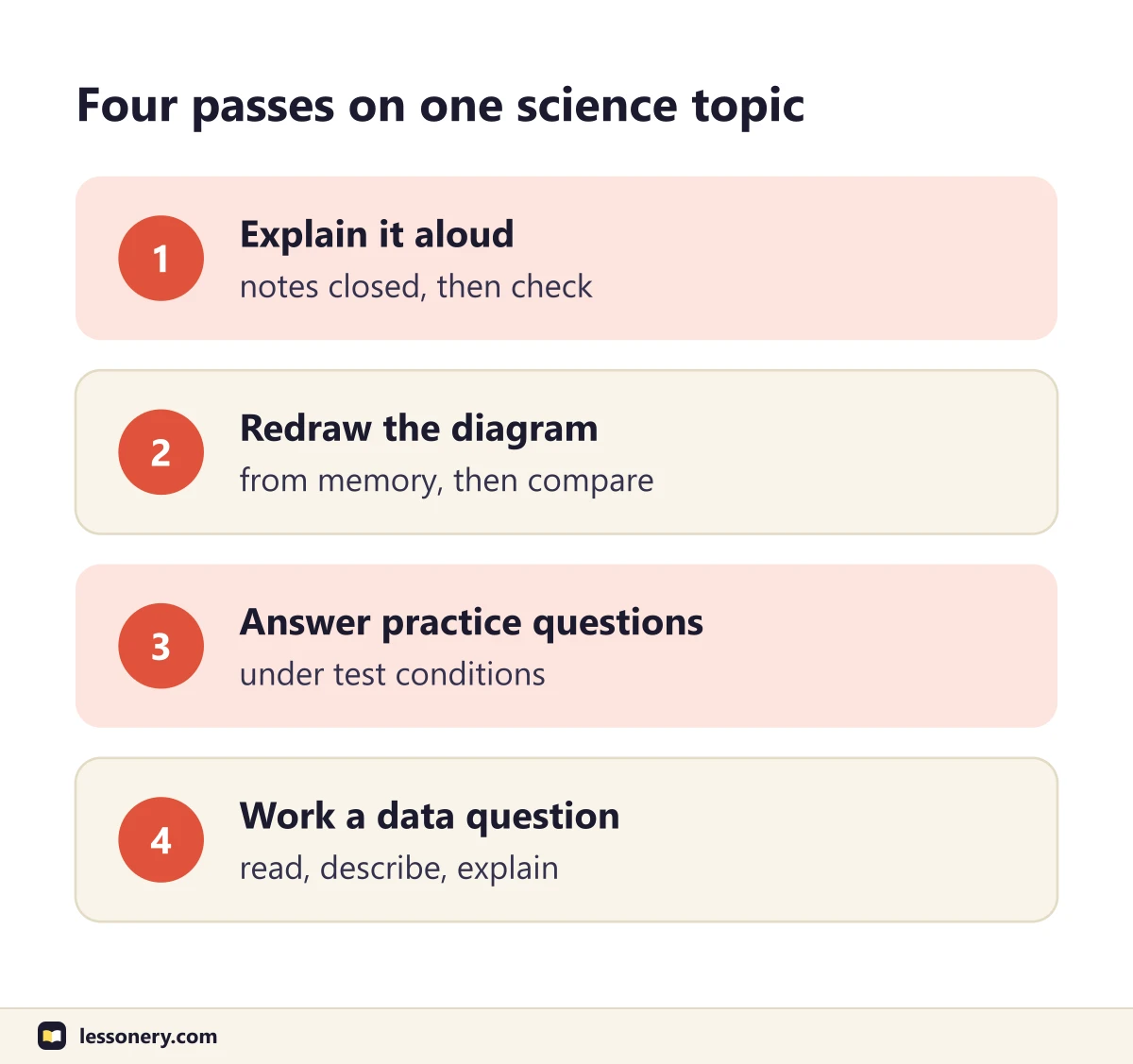
Quick answer: For each topic, explain the process aloud from memory, redraw its main diagram and compare it with the textbook, then answer practice questions under test conditions. Research reviews report benefits for self-explanation, for drawing while learning from science texts and for practice testing, with limits described below.
Why a science exam asks for more than memorized terms
A list of definitions prepares you for one kind of question, and science exams also ask you to use ideas. Crowe, Dirks and Wenderoth (2008) built a tool that sorts biology questions by the kind of thinking they need, using the six levels of Bloom's taxonomy, and tested it on almost 600 questions from college life science exams and standardized tests.
Their study guide for students draws a line after the first two levels. Knowledge and comprehension rely heavily on memorization, which flashcards and mnemonics can reinforce. The higher levels need different practice: predicting what happens when one part of a system changes, interpreting data, designing an experiment.
Advice written for students makes the same point. A tip sheet compiled by two of Dartmouth's Teaching Science Fellows tells students in biology, chemistry and other courses there to prepare to recall concepts, recognize patterns and solve problems through application, and not to stop at reading, highlighting and making flashcards.
The US Institute of Education Sciences practice guide Organizing Instruction and Study to Improve Student Learning recommends prompting students to pose and answer "deep-level" questions that call for explanations. It is one of the two recommendations the guide grades as having strong evidence.
Explain each process aloud: what the self-explanation research found
Self-explanation means explaining to yourself what each part of the material means and how it connects to what you already know.
An early experiment on it used a science topic. Chi, de Leeuw, Chiu and LaVancher (1994) asked 14 eighth-grade students (about 13 to 14 years old) to explain each line of a passage on the human circulatory system to themselves. Ten other students read the same passage twice without that prompt. Everyone was tested before and after.
The prompted group gained more from the first test to the second. Within that group, the students who produced many explanations all ended up with a correct mental model of the circulatory system, while many of the unprompted students and the low explainers did not.
That is one small study. Later reviews give a broader picture:
- Dunlosky and colleagues (2013) rated self-explanation as having moderate utility. Its effects had been shown across subjects, ages and kinds of outcome, but its durability and its performance in real classrooms were still unclear.
- The same review points to the time cost: in the Chi experiment, students who explained each sentence spent 125 minutes on the text against 66 minutes for a rereading group.
- Bisra and colleagues (2018) pooled 69 effect sizes from 64 research reports on prompting learners to self-explain while studying or solving problems. The average effect was g = 0.55 in favor of self-explanation. (An effect size such as g expresses the difference between groups on a standard scale.)
How to do it
- Pick one process: how a signal crosses a synapse, why the seasons change, how a circuit divides current.
- Close your notes and explain it aloud, step by step. The practice guide's question types are useful prompts: why, how, what if, and how one thing compares with another.
- Mark every step where you stopped or went vague.
- Check those steps against your notes and correct them. Nothing else in the routine catches an explanation that sounds fluent and is wrong.
The Dartmouth sheet gives the reason for writing out or saying the whole answer: it shows you the gaps in your understanding. The Feynman study technique is a longer routine built around the same idea.
Redraw diagrams from memory: what the drawing research found
Drawing what a science text describes has helped learners in many experiments, mostly when compared with reading alone.
Fiorella and Zhang (2018) reviewed studies of learning by drawing from science texts. Compared with only reading the text, or with text-focused strategies such as summarizing, creating drawings was consistently more effective for comprehension and transfer. Compared with looking at illustrations supplied by an instructor, or with other strategies that build a mental picture, such as imagining, the results were mixed. The authors add that drawing can be demanding and slow, and that students may not produce good drawings without guidance.
A meta-analysis by Cromley, Du and Dane (2020) covered 53 studies with 8,111 participants, published from 2005 to 2018. The overall effect of drawing to learn was g = 0.69, counting both comparisons between drawing and not drawing and comparisons between kinds of drawing. It was larger for factual outcomes (g = 0.85) than for inferential outcomes (g = 0.44) or transfer (g = 0.22).
The practice guide makes a related recommendation: combine graphics that show processes and procedures with verbal descriptions. It grades the evidence for that as moderate.
One way to turn this into a study step, using the kinds of guidance the Fiorella and Zhang review lists:
- Sketch the diagram with the book closed. Keep it rough: boxes, arrows and labels.
- Open the book and compare your sketch with the printed figure. Comparison with a provided illustration is one of the forms of guidance the review describes.
- Fix what was missing or misplaced, and say what each arrow means as you redraw.
Use practice questions for recall and for application
Practice testing was one of two techniques rated "high utility" in the Dunlosky review, and one classroom study of it was run in science lessons.
McDaniel and colleagues (2011) gave eighth-grade science classes low-stakes multiple-choice quizzes with feedback on part of the content that would appear on unit exams. In the first experiment, three quizzes spread across a unit produced gains of between 13% and 25% on the unit exams. In later experiments, quizzing as a review before the unit exam produced the largest gains, and the benefits of quizzing were still present on semester and end-of-year exams.
For your own practice, three sets of university study advice agree on the conditions:
- The Dartmouth sheet says to do problem sets closed book and to vary the type of practice problem, so you learn to identify what kind of problem you are facing.
- The University of British Columbia's Science Peer Academic Coaches suggest answering past exam questions under test conditions, with a time limit and no distractions.
- A handout on math and science courses distributed by the University of California, Merced, and credited to the University of Texas Learning Center, suggests a practice test with no notes, a time restriction and problems in random order.
The guide to the active recall method covers question formats. For calculation-heavy papers, the article on how to study for a math final explains mixed problem sets and worked examples.
| Activity | What you do | What the research cited here says |
|---|---|---|
| Self-explanation | Explain a process aloud, notes closed, then check | Moderate utility (Dunlosky et al., 2013); average effect g = 0.55 (Bisra et al., 2018) |
| Drawing | Redraw a diagram from memory and compare it with the book | Better than reading alone; mixed against provided illustrations (Fiorella and Zhang, 2018) |
| Practice questions | Answer under test conditions, then mark | High utility (Dunlosky et al., 2013); gains of 13% to 25% on unit exams in eighth-grade science (McDaniel et al., 2011) |
Lab and data questions: read, describe, explain
Questions built on a table, a graph or an experiment are a skill to practice, not content to memorize. A University of Waterloo peer success coach's guide to reading graphs and diagrams starts with the title and the axis labels, which tell you the variables and their units, then the scale, then the direction and slope of the line. It also suggests using specific data points as evidence for a claim.
Crowe and colleagues list two ways to practice. Interpret the data in a textbook figure before you read the author's interpretation, then compare the two. And design an experiment, or state a hypothesis, based on what you are studying.
The table below is invented for this article. It stands for a class experiment that timed how long a fizzing tablet took to finish reacting in water at four temperatures.
| Water temperature (°C) | Time to finish reacting (s) |
|---|---|
| 10 | 95 |
| 20 | 60 |
| 30 | 38 |
| 40 | 24 |
An example of working through it:
- Read. The variables are temperature in degrees Celsius and time in seconds. A shorter time means a faster reaction.
- Describe. As the temperature rises from 10 °C to 40 °C, the time falls from 95 s to 24 s. The steps get smaller: 35 s, then 22 s, then 14 s.
- Explain. Name the idea from your course. Here it is the one the OpenStax chemistry textbook states in its section on factors affecting reaction rates: "Chemical reactions typically occur faster at higher temperatures." A full answer adds the reason your course gives.
The description quotes numbers from the table. The explanation brings in a concept that is not in the table.
Note: Rules on calculators, formula sheets and data booklets are set by your institution. Practice with exactly what you will be allowed to use.
How to study for a science exam: an example five-day plan
The plan below is an example made for this article from the guidance above. It is not a schedule taken from any study, and it assumes one or two study blocks a day.
| Day | Main task |
|---|---|
| 5 days before | List the topics from the syllabus. Write what you recall about each on a blank page and rate it 1, 2 or 3. |
| 4 days before | Weakest topics: explain each process aloud with notes closed, then check and correct. |
| 3 days before | Redraw the main diagrams from memory and compare them with the textbook. Explain the weak topics again. |
| 2 days before | Practice questions under test conditions, including at least two data questions. Start a list of errors. |
| 1 day before | Rework every question on the error list. Short mixed quiz across all topics. Stop early. |
The 1-to-3 rating comes from the method described in how to study effectively for exams, which also covers spacing sessions over several days. The error list follows the Dartmouth sheet's advice to keep a list of problem areas while you study and to review graded work thoroughly.
Frequently asked questions
Do I still need to memorize definitions?
Yes, where the exam asks for them. Crowe and colleagues place flashcards and self-made vocabulary quizzes at the knowledge level, and you can't explain a process without its terms. The point of the sources above is that definitions alone don't prepare you for questions that ask you to apply, predict or interpret.
How do I study for a science exam that is mostly calculations?
Shift the balance toward problems. The handout distributed by UC Merced says that solving problems is usually the most important part of math and science courses, and suggests explaining each step of a worked example in your own words, then closing the book and working the same example yourself.
How many days before the exam should I start?
The studies cited here don't give a number. The example plan uses five days so that each weak topic can be explained, left alone and tested again, which is the logic of a spaced repetition schedule.