
Effective study habits are routines, not techniques: how often you study, when and where, how you plan it, and how you check what stuck. The seven habits below each come with a source, and the evidence is stronger for some than for others.
Much of the research on habits is survey research. It shows what goes along with higher grades, which is not the same as showing what causes them. Each section says which kind of evidence it rests on.
Quick answer: The habits with the most support are studying in short sessions spread over several days, testing yourself as a fixed part of each session, and planning study time ahead instead of following deadlines. Studies also link late-night studying with lower grades and longer, more regular sleep with higher ones, but those findings are correlational.
What counts as a study habit
A technique is what you do inside a session, such as self-testing or explaining a step. A habit is the pattern around it: the schedule, the place, the planning. The techniques are compared in the overview of the most effective study techniques.
One survey appears several times below. Hartwig and Dunlosky (2012) asked 324 undergraduates at Kent State University in the United States, drawn from a participant pool made up mainly of introductory psychology students, how they studied, and compared the answers with each student's grade point average (GPA, the average of course grades used in US universities). The GPAs were self-reported and the relationships were small, so read its results as patterns, not as cause and effect.
Scheduling habits: spread the sessions, plan the week
1. Study in short sessions spread over several days
Spreading study of the same material over time is called distributed practice. In their review of ten learning techniques, Dunlosky and colleagues (2013) rated it as high utility because it works across ages, across many kinds of material and over long delays. The US Institute of Education Sciences practice guide Organizing Instruction and Study to Improve Student Learning lists "space learning over time" as its first recommendation, with a moderate level of evidence.
As a routine, the University of North Carolina's Learning Center suggests working a short time on every class each day, in focused sessions of 30 to 45 minutes with a break after each. Its example is 30 minutes a day on a project instead of four hours on Monday.
One caution from the Kent State survey: students were split roughly evenly between spacing and massing their study, and reported spacing was not significantly related to GPA. The strong evidence for spacing comes from experiments, not from that survey. How to set the gaps is covered in the guide to a spaced repetition schedule.
2. Plan the week before deadlines plan it for you
In the survey, the most common way of deciding what to study was to pick whatever was due soonest. About 13% of students said they planned their study ahead of time. Lower performers relied more on impending deadlines, and higher performers were more likely to plan ahead.
UNC describes a weekly planning routine in six steps: plan on the same day each week, list what you want to complete for each class, count the hours you have, estimate the time each task needs, put specific work times in your calendar, and plan the next day each night.
Broader evidence comes from a meta-analysis by Aeon, Faber and Panaccio (2021) covering 158 studies and 53,957 participants. It found time management moderately related to academic achievement, with links to every kind of results-based academic outcome it examined except standardized tests. Most of those studies were cross-sectional, so they show association only. A template is in the article on a weekly study schedule.
Habits inside each session: test yourself, then check again later
3. Make self-testing part of every session
Of the effective study habits listed here, self-testing has the clearest support. Dunlosky and colleagues rated practice testing as high utility, and the IES guide grades its recommendation to use quizzes to re-expose students to material as strong evidence.
In the Kent State survey, 71% of students said they tested themselves, and testing with questions or practice problems was positively associated with GPA. The most common reason students gave for self-testing, chosen by 50% to 60% of them, was to see how well they had learned something. That is a fair use of it, but the experimental research treats testing as a way of learning too. The method itself is laid out in the guide to the active recall method.
4. Check what you know after a delay, not right away
Judgments made straight after studying tend to be too generous. The IES guide reports that learners typically overestimate how well they have mastered material when they finish studying, and calls this the illusion of knowing.
Its remedy is a delayed check: wait an hour, a day or a week, look only at the question, and judge whether you could answer it. The panel grades the evidence for this recommendation as low (the guide's web page uses the label "minimal"), because most of it comes from laboratory studies, not classrooms. One way to make it a habit is to open each session with a few questions on what you studied last time.
When and where you study
5. Study at the hours when you are alert
In the Kent State survey, most students studied in the evening and 20% studied late at night. Fewer than 15% studied in the afternoon or earlier, although 42% believed the morning or afternoon was their most effective time. Late-night studying was most common among the lowest performers.
That is a correlation, and it does not show that late hours lower grades. UNC's advice is simply to know when you study best, noting that your focus at 10:00 p.m. may be weaker than at 10:00 a.m.
6. Choose a place with few distractions, and have more than one
UNC suggests finding the noise level that suits you, identifying several study spots, and moving on when one becomes too comfortable to focus in. It also recommends turning off your phone and not using your computer when the work doesn't need it, citing research by Junco and Cotten (2012) for its statement that multitasking increases the time needed to learn and lowers the quality of learning.
There is some laboratory support for varying the place. In the first of five experiments by Smith, Glenberg and Bjork (1978), studying in varied environments produced higher free recall than studying in one unchanged environment. That is a memory experiment, not a classroom study, so the practical weight is modest. Distraction has its own guide: how to not get distracted while studying.
Sleep and study: what the research describes
7. Regular sleep across the term
Two studies that tracked students with wearable devices found that sleep and grades move together.
Okano and colleagues (2019) followed 88 students in an introductory chemistry course at MIT for a 14-week semester. Longer sleep, better sleep quality and more consistent sleep were each associated with higher course scores. In the paper's regression, the three measures together accounted for 24.44% of the variance in overall grade performance, a figure its abstract gives as "nearly 25%". Sleep on the single night before a test showed no significant link with that test's score.
Creswell and colleagues (2023) measured sleep for about a month early in the term in 634 first-year students at three US universities. Students averaged 6 hours 37 minutes a night, and each hour less of average nightly sleep was associated with a 0.07 lower end-of-term GPA, after accounting for the previous term's GPA.
Both are observational. Both sets of authors say that stress, mood and other unmeasured factors could affect sleep and grades alike, and that controlled trials would be needed to show cause.
Note: This section describes research and is not health advice. If you regularly struggle to sleep, or feel unable to cope with your workload, speak to a doctor, a counselor or your school's student support service.
Effective study habits at a glance
| Habit | What it looks like | Source and type of evidence |
|---|---|---|
| 1. Spread sessions over days | 30 to 45 minutes per course, most days | Dunlosky et al. (2013), review of experiments; IES guide, moderate evidence |
| 2. Plan the week | One planning session on the same day each week | Hartwig and Dunlosky (2012), survey; Aeon et al. (2021), meta-analysis of mostly correlational studies |
| 3. Self-test every session | Closed-book questions or problems | Dunlosky et al. (2013); IES guide, strong evidence |
| 4. Check again after a delay | Start with questions on the last session | IES guide, low evidence |
| 5. Study when alert | The time of day when you focus best | Hartwig and Dunlosky (2012), survey; UNC guidance |
| 6. Low-distraction places | Phone away; two or three regular spots | UNC guidance; Smith et al. (1978), laboratory experiment |
| 7. Regular sleep | A steady pattern across the term | Okano et al. (2019); Creswell et al. (2023), observational |
A sample week that combines the habits
The plan below shows how these effective study habits can fit into one week. It is an example written for this article, for a student taking three courses, and it is an illustration to adapt, not a schedule from any of the sources.
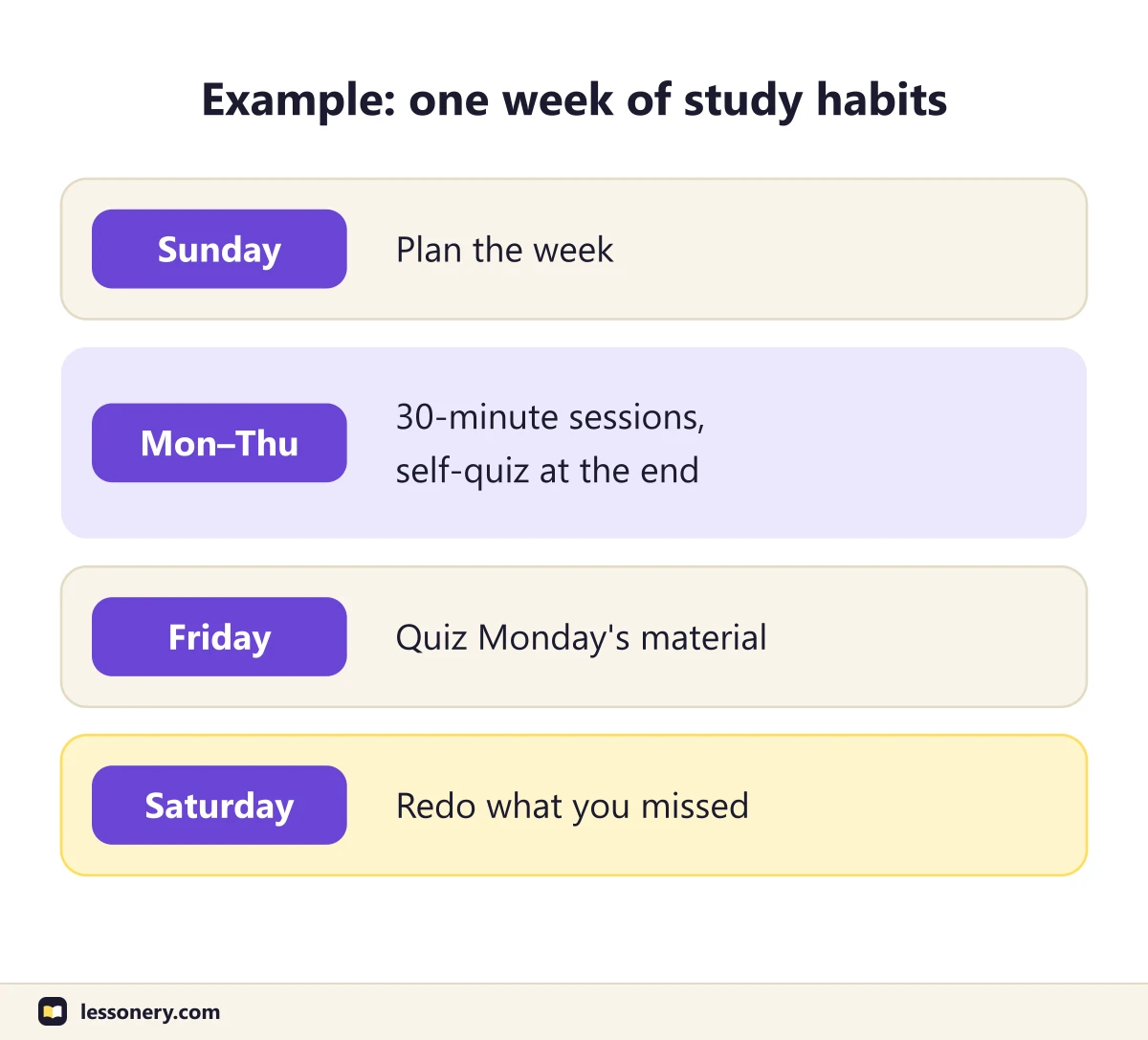
| Day | What happens | Habit |
|---|---|---|
| Sunday | Spend 20 minutes planning the week: list tasks for each course, estimate the time, and put sessions in the calendar | 2 |
| Monday to Thursday | Three 30-minute sessions in the late afternoon, one per course. Each ends with a five-minute closed-book self-quiz | 1, 3, 5 |
| Friday | Quiz yourself on Monday's material without notes and mark what you missed | 3, 4 |
| Saturday | One session to redo what you missed, in a different study spot | 4, 6 |
The plan keeps the late evening free of study on every day, which leaves room for habit 7.
Frequently asked questions
How many hours a day should you study?
None of the sources here sets a number of hours. UNC suggests short focused sessions of 30 to 45 minutes and, as a baseline, about 30 minutes on each class every day. How much you need beyond that depends on your courses, so check what your own teachers or institution expect.
Is it better to study in the morning or at night?
The research described here does not settle it. In Hartwig and Dunlosky's (2012) survey, late-night studying was most common among the lowest-performing students, and Okano and colleagues (2019) found that earlier bedtimes went with higher course scores. Both findings are correlations.
Is cramming ever effective?
In the short term, yes. Dunlosky and colleagues (2013) write that cramming is better than not studying at all and that massed study can help on an immediate test. The same review found that distributed practice typically does more for long-term retention. For the emergency case, see how to cram for an exam.
Should you always study in the same place?
Not necessarily. UNC recommends having several study spots, and one laboratory experiment (Smith, Glenberg and Bjork, 1978) found better free recall after studying in varied environments. The evidence is limited, so a place where you can concentrate matters more than a rule about variety.